
“I moved out here to get away from exactly that — the light, the noise, everything [a data center] brings is disgusting,” — Houston Brautigan, Jarrell resident
Houston Brautigan moved to Jarell after leaving his hometown of Ashburn, Virginia — a city nicknamed “Data Center Alley” — about six years ago.
He hoped to enjoy the rural, small-town life found in rual Central Texas communities, and to escape what he saw as growing concerns surrounding the data centers near his former home. Within the past 10 years, Ashburn has gained 170 data centers and houses more than 70 percent of the internet’s traffic through the various facilities.
“I moved out here to get away from exactly that — the light, the noise, everything [a data center] brings is disgusting,” Ms. Brautigan said.
Unsurprisingly, Ms. Brautigan was one of a dozen Jarrell residents last fall who spoke up against a new data center near Jarrell High School during a city council workshop in September 2025.
“I’ve lived there, I’ve done that,” he said. “I moved 1,200 miles to get away from that. The last thing I want to do is to have one built half a mile from my house.”
The proposed Mesones Data Center is projected to generate an estimated $7.2 million in revenue for Jarrell once it is operational. Three partners are on the development team: Prominent Property Group, Savannah Developers and Power Infrastructure Partners.
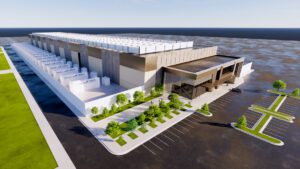
Utility agreements, development and tax incentive agreements have yet to be finalized for the project. However, the property was zoned for potential data center use after the September meeting.
“I hate that I have to fight here tonight,” Mr. Brautigan said to the city council. “It won’t be the last [data center]. You are opening the door.”
Technology companies such as Apple, Dell, Samsung and Tesla have been drawn to the area for decades, but residents have started to see the rise of data centers in recent years.
On the other side of Williamson County, Round Rock City Council in February approved a zoning change for a Skybox AI data center facility. The center will be built on about 30 acres just southeast of the A.W. Grimes and Old Settlers Boulevard intersection. Plans show a 150,000-square-foot facility, which would be located just north of the Chandler Creek neighborhood.
Sabey Data Centers off Louis Henna Boulevard in Round Rock will house the University of Texas at Austin’s Horizon supercomputer for scientific research this summer, according to a news release from the university.
The trend continues in Taylor. During the March 26 City Council meeting, Taylor officials greenlit ordinances to move forward on a 210-acre data center next to the Samsung Manufacturing Site located on County Road 410 and Farm to Market Road 973. Ben White, the CEO of Taylor’s Economic Development Corporation, said the 2.5 billion project would generate $145.9 million in revenue for the city and $70.7 million for Taylor ISD.
“This is going to benefit our citizens in the future,” Taylor Mayor Dwayne Ariola said.
Data centers: What are they?
Previously called computer rooms, server rooms, and machine rooms, a data center is essentially “a warehouse with computers in it,” explained Dan Stanzione, executive director of the Texas Advanced Computing Center at UT.
Dating back to the early 2000s, he said data centers house the computing services needed to perform online functions, from searching for answers on Google to using an iPhone’s map navigation. Most recently, data centers are used to support artificial intelligence.
He said the demands of AI operations began increasing in 2022, and has led to computer chips getting denser, which requires an increase in power, size and overall costs for data centers.
The estimate for AI infrastructure in the U.S. was about $400 billion in 2025, Mr. Stanzione said. That includes the data center itself and all the servers, chips, etc. within one.
“This is way larger than the market was four or five years ago,” he said. “The local server market is something like five times bigger than it was five years ago, so we’re still dealing with the fact that there’s not enough supply.”
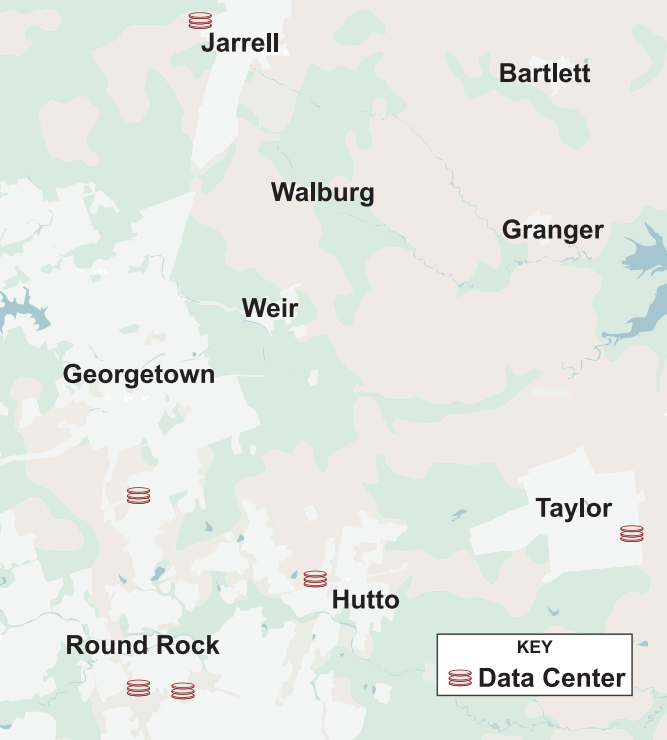
There are an estimated 389 data center properties in Texas, with about 30 in the Austin area and six properties in Williamson County specifically, according to datacentermap.com, an online database.
Those six properties are:
- Blueprint DC, 1201 Westinghouse Road, Georgetown
- Blueprint DC, 1601 East MLK Jr. Boulevard, Taylor
- Colovore, 2351 Innovation Boulevard, Hutto
- Sabey Data Center Properties, 1300 Louis Henna Boulevard, Round Rock
- Skybox, 2501 East Old Settlers Boulevard, Round Rock
- Switch, 150 Dell Way, Round Rock
The Sun reached out to Skybox, Blueprint and Savannah Developers for comment, but did not receive a reply by press time.
Environmental concerns
Residential pushbacks against data centers during both Jarrell, Taylor and Round Rock City council meetings revolved around demands on land, the power grid and water supply for cooling, as well as noise and air pollution.
Round Rock resident Kim Hollowell said she was worried that air quality would worsen if the data center were built.
“We have families in this area – myself included – that deal with respiratory illnesses,” she said. “These facilities aren’t clean. They rely on rows of diesel generators for backup. Residents where data centers have gone up report the noise and air pollution they bring and the impact that pollution has on their health.”
Cases of hypertension, heart palpitations, chest pain, vertigo, tinnitus, migraines and panic attacks rose among the residents of Granbury, Texas, after a bitcoin data set up shop in 2024, according to Time Magazine. Similar medical complaints have been registered near facilities in Arkansas and North Dakota.
As of writing, there is no official study that concludes data centers have these effects. However, there are growing cases pairing prolonged noise pollution with cardiovascular damage.
These are common concerns, Mr. Stanzione explained, pointing to noise and water supply concerns specifically, although some centers can be designed to lessen the impact.
For the Skybox project, the facility will be a closed-loop cooling system. This means the facility will use 20,000 gallons of water – which is the amount of a residential swimming pool – and recycles it to cool the commuters.
“This is really important to use because it ensures that the water usage is really, really limited to the property,” said Brad Dushkin, Round Rock’s director of planning. “This helps us use very little water for these projects, whereas older data centers in other parts of the state and other parts of the county rely on evaporation cooling.”
Representatives with Skybox — which also operates a facility in Pflugerville – said they feel Round Rock is a good fit for the operation.
“Skybox believes that Central Texas – and Texas as a region – is incredibly important to the overall data center infrastructure of the state, to the progress of technology in the western world and we like the ability to do that here,” Skybox Chief Development Officer Haynes Strader said to the Round Rock City Council. “We are the right partner for your community, and I truly mean that.”
Calling Texas home
Although data center facilities are popping up across the U.S., Texas is predicted to become the nation’s leading data center market within the next three years, according to a 2026 report by California-based energy company Bloom Energy.
“By 2028, Texas is projected to exceed 40 gigawatts of capacity — nearly 30 percent of total U.S. demand — representing a 142 percent increase in market share relative to today,” the report indicates.
Texas has the build-out capabilities, favorable tax structures, and power and land needed to run data centers cheaply compared to other states, Mr. Stanzione said, leading to local growth.
“It’s where it’s easy to get substations, easy to add power, and the power is fairly affordable, because – to a large degree – it doesn’t matter where you are, as long as you have power and good fiber,” he said. “Favorable power costs, favorable land costs, good construction environment versus a lot of other states, makes Texas a harder market, particularly the east and west coast, where power is a lot more so.”
What the future holds
From an academic research perspective, Mr. Stanzione said there is a lot of speculation around how big the AI industry is going to be in the future.
“A lot of it is going to come down to how fast the promises of AI are realized and adopted, and how big the marketplace is,” he said. “I think there’s going to be a lot of demand for AI, and it’s certainly going to impact a ton of jobs down the line, but not everybody who's building out now is going to be the winner.”
As for the Mesones Data Center, the Jarrell City Council is still in the process of finalizing agreements for the property. The Skybox data center in Round Rock will still have to go through the platting and permitting process with the city.
“There are probably places where these things do belong, but there are certainly places where they do not belong,” said Aidrean Shelly, who attended the Round Rock city council meeting. “I think a residential community is a fine example of a place that doesn’t need to play host to an industrial facility like this.”