
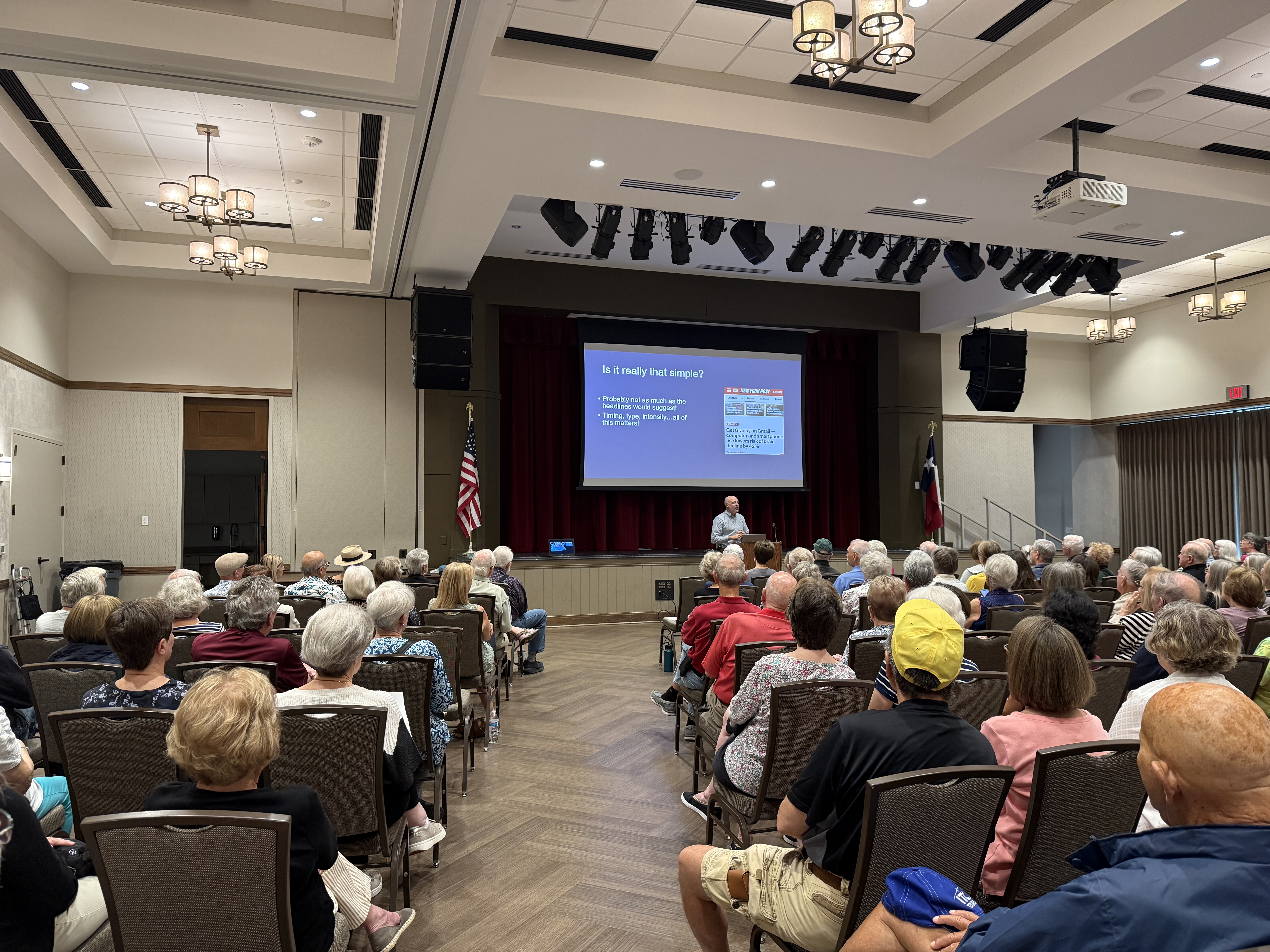
The Dell Medical School at the University of Texas at Austin is launching the BRAINFIT study, exclusive to Sun City residents.
Researchers are seeking people over age 60 who are healthy or experiencing mild cognitive decline. The study aims to learn how the brain stays healthy with age by observing electronic signals during certain activities.
Dr. Jared Benge, a principal investigator in the study, is an associate professor at UT Austin and a neuropsychologist in UT Health Austin’s Comprehensive Memory Center. He has spoken in Sun City multiple times about scientific advances in delaying neurodegenerative diseases. His research focuses on how healthy adults age and how those insights could help prevent or delay cognitive decline.
He suspects Sun City residents are a good group of study participants.
“[In] the Sun City community, you see a group of individuals that are doing a lot of the right things from a brain health standpoint,” Dr. Benge said in an interview with the Sun. “They tend to be socially connected, physically active and managing their other health factors.”
The BRAINFIT study will involve participants taking a cognitive assessment and survey about lifestyle factors. Then, participants wear small electrodes fixed to the outside of their scalp to measure brain waves while performing a series of light tasks, from riding a recumbent bike to playing computer games.
“We know these things are good for brain health,” Dr. Benge said. “But, we don’t really know what happens in the brain to make these things helpful.”
The lab study takes about three and a half hours. Benge said researchers hope to hold it annually in the Sun City Computer Lab, depending on funding. He and his team aim to use findings to one day develop personalized approaches to cognitive medicine.
“If we know some of these markers of brain health and how activities that we do every day may promote these brain healthy signals,” he said. “Maybe there’s ways to optimize and build upon that signal.”
Community involvement
Dr. Benge has given presentations in association with the Georgetown Neuroscience Foundation. The foundation, started four years ago by retired professor Dr. Michael Douglas, has about 1,200 members. Its mission includes helping recruit participants for UT Dell Medical School studies and providing education.
“The idea was, let’s go to the top-tier journals that have been vetted and then provide the information in a digestible form for the layman,” Mr. Douglas said.
Jan Fambro, who has written newsletters for the foundation, helped organize Dr. Benge’s September 26 presentation introducing the study, where about 220 people attended. She said many residents were excited to contribute to the research. So far, 165 people have signed up expressing interest in BRAINFIT.
Liz Blount was one of the attendees, and she is interested in becoming involved. She is a member of the Georgettes drill team in Sun City, but said she’s noticed that it has become harder for her to learn and remember her dance routines. Although she considers herself healthy, she said she would like to participate to help the researchers come up with treatment, should she one day develop a disorder.
Sun City presentation
During the September 26 talk, Dr. Benge discussed the Nun Study, a landmark 1986 project by epidemiologist David Snowdon. The study followed School Sisters of Notre Dame nuns to measure aging and dementia. One participant, Sister Mary, maintained high cognitive function until her death at age 101. An autopsy revealed her brain showed signs of Alzheimer’s disease despite no clinical symptoms.
“She was a cognitive rock star all the way to the very end of her life,” Dr. Benge said. “She had significant Alzheimer’s pathology, but didn’t have clinical symptoms of Alzheimer’s.”
He compared the finding to how Covid-19 affected patients differently during the pandemic. He pointed out that some people who tested positive for Covid had no symptoms, while others ended up in the ICU.
“The symptoms vary dramatically, person to person,” Dr. Benge said. “Well, it turns out that with Alzheimer’s pathology, the same thing is true.”
The Nun Study also found that nuns who wrote strong essays as teenagers were less likely to develop Alzheimer’s symptoms, even if their brains later showed disease markers. Benge said this points to “cognitive reserve,” the brain’s ability to adapt and maintain function despite damage.
Cognitive reserve is the brain’s ability to withstand damage and maintain cognitive function. This involves the brain utilizing alternative pathways during disease, aging or injury. Cognitive reserve can be built by education, engaging in stimulating hobbies and physical exercise.
“[People with high cognitive reserve] may have a steeper change at the end,” he said. “That’s kind of a hotly debated area, but overall, individuals can have the same degree of pathology and develop symptoms differently and at different times.”
Other areas of research
The BRAINFIT study is one of many being pursued to measure aging and cognition.
“We’ve got a plethora of studies,” Dr. Benge said. “We try to have something available for anyone who’s interested.”
Dr. Benge is studying how technology affects aging brains. One project compares using Google Calendar with a paper calendar among participants with mild cognitive impairment or dementia. Previous research suggests technology supports brain health. There is another study, in José del R. Millán’s lab, looking at the effect of transcranial stimulation.
“This is basically using a large magnet to change the firing in individual neurons,” Dr. Benge explained. “And we can pair this with a video game system to where if you start to make an error, we can tailor stimulation to those errors.”
Research coordinator Rovi Tindaan recruits for UT’s various studies. She said she matches participants by interest, schedule and ability. Those interested can email techsanslab@ austin.utexas.edu or call 512-495-5285.