
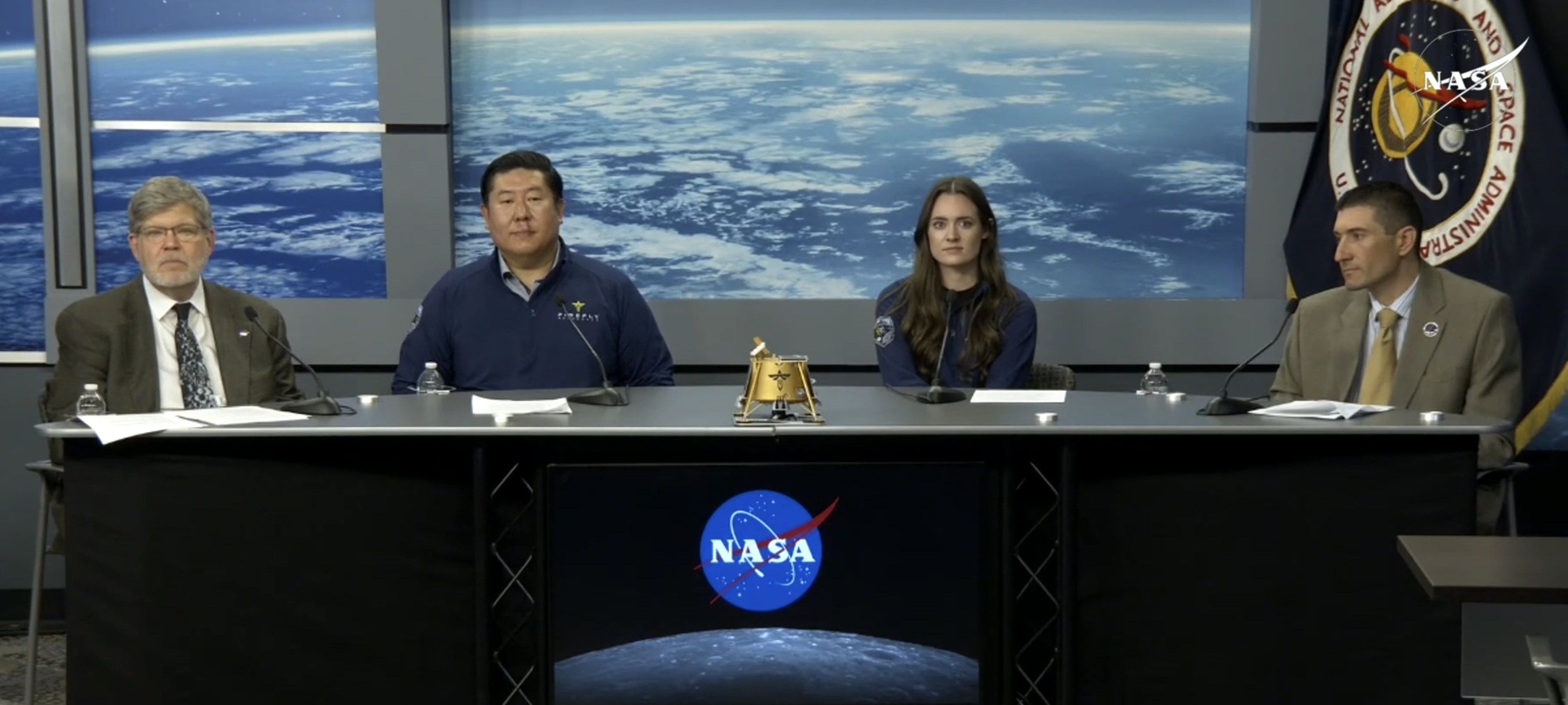
Firefly Aerospace — a private aerospace company with headquarters located in Cedar Park — successfully completed Blue Ghost Mission 1 in partnership with NASA.
On March 16, the company’s unmanned Blue Ghost lunar lander completed 14 days of surface operations on the moon and operated over 5 hours into the lunar night. This marks the longest commercial mission on the moon to date.
The mission was funded by NASA’s Commercial Lunar Payload services, a program dedicated to collecting data that could help human space missions in the future.
Reflecting on the mission
Firefly Spacecraft Program Director Ray Allensworth reported that the mission’s most intense moment was when the lander touched the moon’s surface. The landing was autonomous, which made the team feel as though they had given up control. She described it as “a tense moment followed by an equal amount of joy” as the lander landed perfectly.
“We had this 12 to 14 minute period where we were just waiting, and data was just coming at [us,] and we really couldn’t do anything about it,” Ms. Allensworth said.
She pointed to the moon’s thermal environment as something the team had to “actively learn” about while the vehicle was on the moon’s surface.
“We knew lunar noon would be happening, but we didn’t initially understand how the interaction of the sun and the craters would work,” she explained. “The team, live, took that data, updated models and applied it forward.”
Ms. Allensworth reported the team collected even more data than expected on the mission.
“As a bonus, we were able to capture the solar eclipse and subsequently the lunar sunset,” said Jason Kim, Firefly chief executive officer.
Dr. Joel Kearns, the deputy associate administrator for exploration at NASA, called Firefly’s broad set of data very impressive.
Scientific implications of the lunar sunset images
The images collected during and after lunar sunset will provide further information on what is called the lunar horizon glow, Dr. Kearns said. He believes the light phenomenon, “may have been caused, in part, by sunlight scattering through a cloud of electrostatically charged particles.”
Lunar horizon glow was first observed by robotic probes and was reported by astronauts in the 1960s. He said these new images will have to be analyzed by professionals to be certain what causes it.
“I think what we have at this point is a really beautiful, aesthetic image showing some really unusual features and the specialists have to really look at it and decide what conclusion they can draw from it,” Dr. Kearns said.
Business going forward
Mr. Kim explained Firefly as “a rocket company that evolved into a fully integrated space company that does lunar landers and satellites as well.”
“Right now, we are expanding our facility in Cedar Park,” he said. “We got a really hard earned, Texas state commissioned grant to do so.”
He projects the company to produce one lunar lander each year.
“I can foresee one a year right now,” he said. “As we talk to more [potential] customers in addition to NASA, it might grow to multiple a year.”
NASA is working toward the Commercial Lunar Payload Services objective of two task orders per year.
When asked if Mr. Kim sees NASA becoming a minority customer as the company is approached with more commercial opportunities, Mr. Kim said he foresees Firefly having a very balanced approach of supporting NASA, national security and commercial interests.
“NASA is always going to be a big part of Firefly’s mission,” he said. “As [Dr. Joel Kearns] taught me, science really pushes exploration and exploration really pushes science.”
Ms. Allensworth said in early April, the Firefly team is going to try to power on the lander after the lunar night. She said the probability they get a signal is very low, but she is optimistic.