
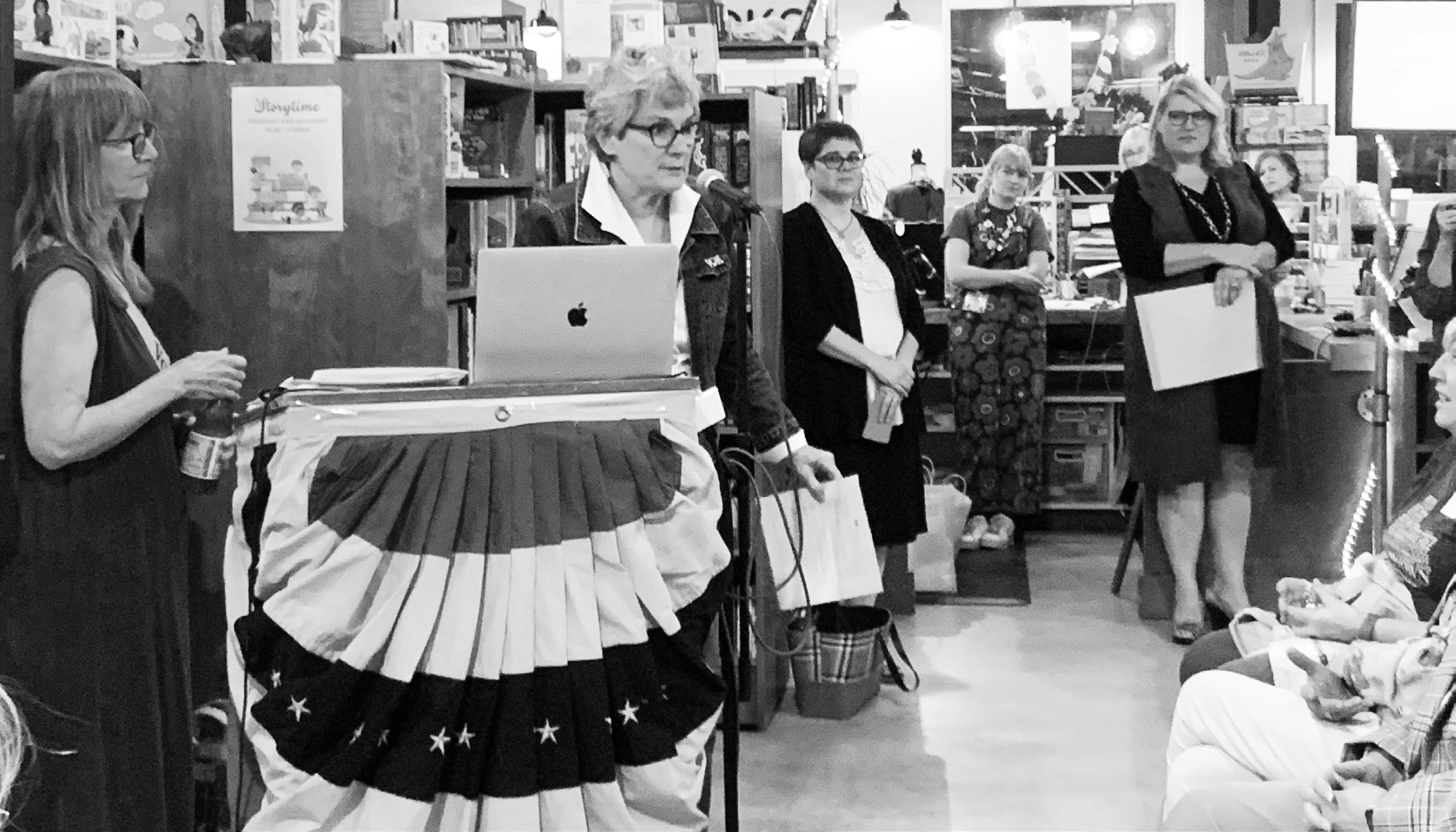
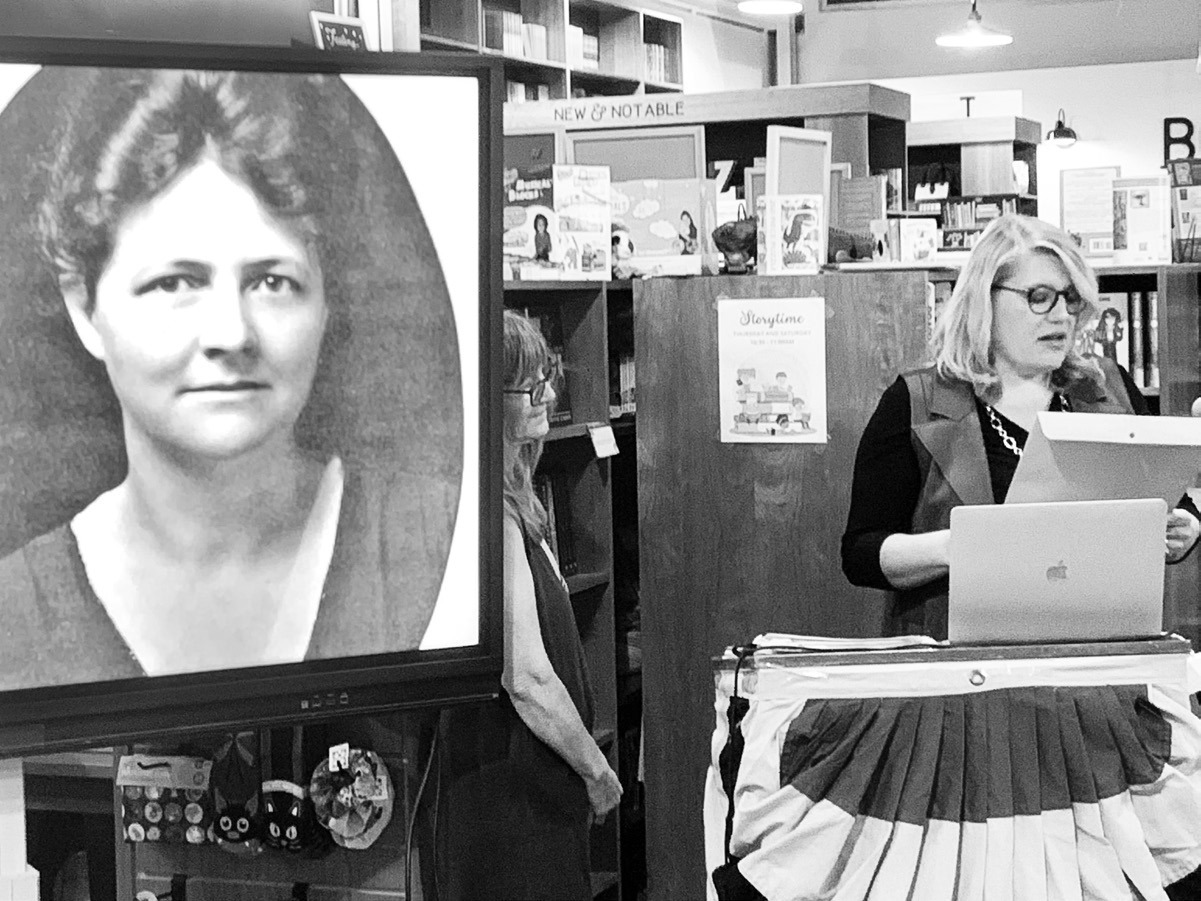
Lark & Owl Booksellers was bustling with roughly 65 people — a crowd made up of mostly women — who gathered Wednesday, November 2, to celebrate the life of Jessie Daniel Ames.
The event, which celebrated what would have been Ms. Ames’ 139 birthday, was hosted in partnership with the League of Women Voters of Williamson County.
“We are thrilled to have y’all because to say that we support a woman who fought for fairness, social justice and equality is an understatement,” said Jane Estes, Lark & Owl co-owner.
Born on November 2, 1883, Ms. Ames was a suffragist and anti-lynching advocate who spearheaded grassroots efforts to improve the lives of underrepresented people throughout Williamson County, the state and eventually, the Southern U.S.
Her most notable accomplishments include launching the Georgetown Equal Suffrage League, which worked diligently to bring women’s suffrage to Texas, helping to found the Georgetown branch of the American Association of University Women, acting as the first president of the Texas League of Women Voters and serving as director of the Texas Council of the Commission on Interracial Cooperation.
The Wednesday event, coined Jessie Fest by its organizers, featured the reading of two proclamations passed by both Williamson County and the City of Georgetown, naming November 2 as Jessie Daniel Ames Day. The proclamations were read by Precinct 1 Commissioner Terry Cook and District 1 Council Member Amanda Parr.
“I am honored to have been asked to do this as the only woman city council member,” Ms. Parr said. “I am very happy on behalf of the city of Georgetown to read this proclamation.”
Additional speakers included Joyce LeBombard, president of the League of Women Voters of Texas, and Helen Cordes, who runs the First Vote program for the League’s Williamson County branch.
A fight for voting rights
Ms. Cordes gave a presentation, which lasted roughly one hour, about Ms. Ames’ life during the event.
“I want to tell you about Jessie but also about the culture and the politics of what was going on and why what she did was so important,” Ms. Cordes said. “This is 100 years later, but I think a lot of the issues have not changed. Jessie fought hate against Black people, against women.”
Like many women, Ms. Ames filled many different roles throughout her 90 years of life, Ms. Cordes said. These included that of a daughter, sister, mother, co-owner of the Georgetown Telephone Exchange, writer and advocate. Ms. Ames was also a college graduate. She received a bachelor of arts degree from Southwestern University's women’s annex in 1902.
Ms. Ames was a trailblazer when it came to pursuing suffrage forwhitewomen.Shegavespeeches and hosted rallies throughout Central Texas to educate and gain the support of women and men who believed in suffrage efforts. Her work, along with the efforts of her fellow suffragists, resulted in 3,800 Williamson County women registering to vote in the 1918 Texas primary election.
Ms. Ames remained active in her efforts until and after the 19th amendment was ratified in Texas in 1919 — a fact that was celebrated Wednesday with a sing-a-long to Dixie, but with lyrics previously tweaked by suffragists to fit the movement.
“There is growth and grace in the land of cotton, where women’s rights are not forgotten,” sang the crowd, which was led by Ms. Cordes. “Look away, look away, Texas land.”
Advocating for the Black community
While suffrage was a huge victory for Ms. Ames, she knew her work had only just begun.
Women of color were cut out of Texas elections because of whites only voting rules, as well as poll taxes placed specifically to limit who could cast a ballot, Ms. Cordes said.
At the same time, racially motivated violence continued to take place throughout the state and the entire South. This was in part due to a rise in Ku Klux Klan membership, Ms. Cordes said. Lynchings — when mobs would kill people of color who were alleged to have committed a crime — often took place without any sort of legal trial beforehand, Ms. Cordes said. They were often publicly framed as a way to “protect white women” from Black men in the 1800s and 1900s.
Ms. Ames spoke out against these actions and began investigating racial violence and inequity on her own. In 1922, she was selected as director of the Texas Council of the Commission on Interracial Cooperation, a job that eventually took her to Atlanta to lead the regional office. In 1930, she founded the Association of Southern Women for the Prevention of Lynching, a group of white women who organized to reduce racial violence within communities.
“Jessie intentionally kept membership to white women,” Ms. Cordes said. “She believed it was not the Black women’s burden to change white men. She noted that fighting lynching was extra dangerous for Blacks. She was also mindful that whenever Blacks were involved with an organization or cause, white resistance went up.”
Through the association, Ms. Ames trained women to investigate lynchings themselves, collect facts about the event and to try to gain the trust of the Black community to get information from them as well. The women would then spread the word and report the incidents to law enforcement, calling on them to uphold their duties to prevent heinous crimes.
While Black women were not part of the association, Ms. Ames did seek advice from the Black community when determining the best ways to fight against racial violence, Ms. Cordes noted.
By 1942, the association had received 43,000 pledges from people committing to speak and act out against lynchings.
Lasting legacy
After a life filled with advocacy, Ms. Ames died on February 21, 1972. She is buried in the International Order of Odd Fellows Cemetery in Georgetown. She is recognized locally by a historical marker positioned outside her 1004 Church Street home, which is now a private residence.
Ms. Ames’ work is continued on by the Texas League of Women Voters, the organization she helped to found.
“Jessie Daniel Ames, like all of us, was a complicated woman with faults and blind spots,” Ms. Cordes said. “She was stubborn, goal oriented and opinionated, you know, compliments when said about men. But there is no question that she carried the torch with great courage.
“Ames made the world much better here in Georgetown and far beyond.”
In addition to the presentation, Jessie Fest included door prizes, which included voting-themed decorative pins, t-shirts, gift cards and a League of Women Voters’ membership. A birthday cake with red, white and blue frosting and the word “vote” written across it was also shared by attendees.
Correction: In previous Jessie Fest coverage, the Sun published Jessie Daniel Ames’ birthday incorrectly. She was born November 2, 1883.
PHOTOS BY BRIGID COOLEY