

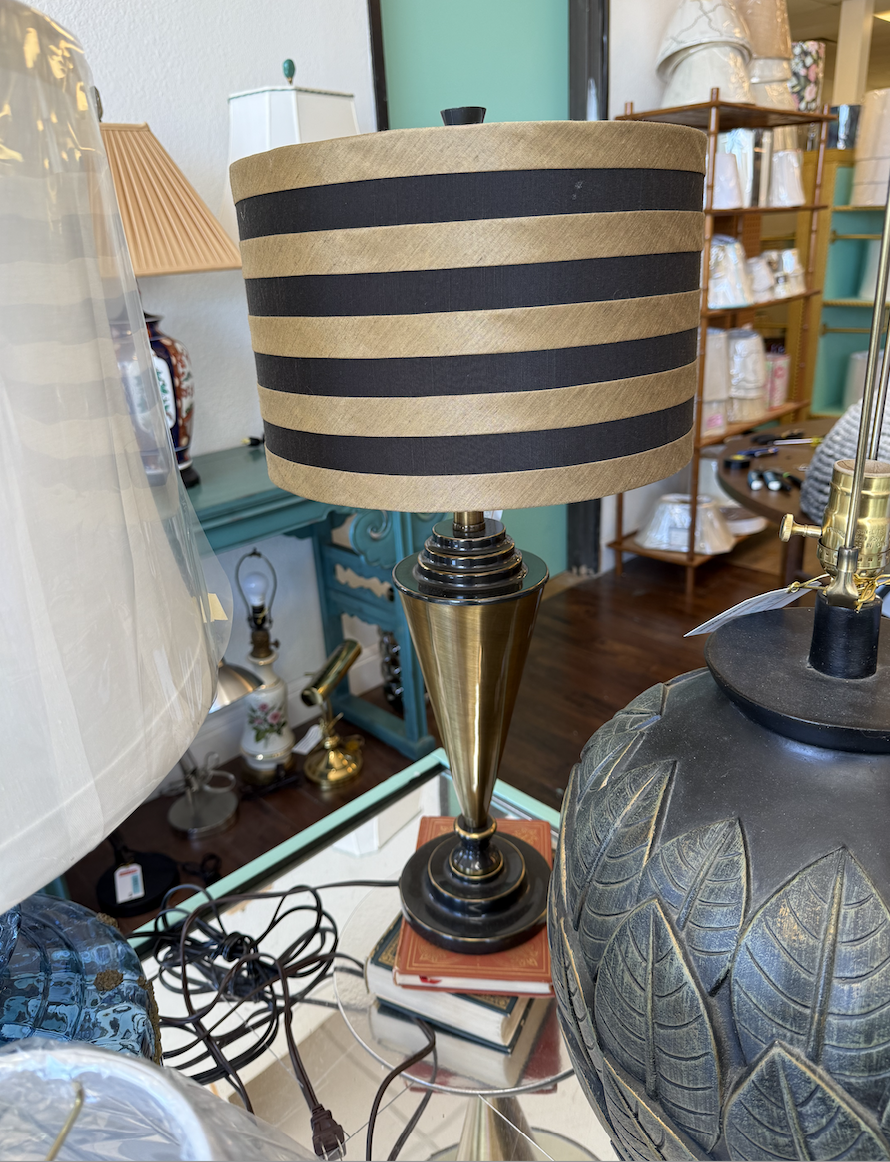
Austin Lampworks offers a unique perspective on the lighting industry by combining sentimentality and creativity. The eclectic Georgetown store provides lamp repairs, custom lamps and custom shades.
Owner Gary McNabb runs the business with his son, Kevin. After running it as a home business for many years, Austin Lampworks moved to a brick and mortar on Williams Drive a year and a half ago. Now it shares a the space with new tenants Bella & Birdie and All Things New, which Mr. McNabb said has boosted foot traffic overall.
The front of the interior design shop displays a collection of lamps for sale. It’s a mix of items Mr. McNabb has found at estate sales or made himself, and the various styles can inspire those seeking custom works. He said he can ‘make anything’ into a lamp. He personally creates lamp bases, and works with USA manufacturers to create one-of-a-kind shades.
“People will bring in things that have sentimental value to them that they want to have turned into a lamp,” he said.
There was a geologist who brought rock from 1,000 feet underground; a woman, who brought in her father-in-law's drill from the 1940s; and a musician who wanted to turn their old bass clarinet into a floor lamp. Common requests include cow skulls and antique guns.
“After a while, you lose perspective on what the crazy things are,” he said.
There was one customer who brought in their taxidermied pet.
“Someone had a beloved little terrier. They had it preserved after its passing,” he said. To fulfill the customer’s vision, Mr. McNabb decorated a piece of marble with fake grass to make it “look like a natural setting.” He then put a curved rod over the dog’s head and attached a lamp shade on top. “We used a black shade with a gold foil interior, so all the light reflected down on the dog like a spotlight,” he said.
Restores and repairs
Repairs and custom shades are the bulk of Austin Lampworks’ business. Mr. McNabb restores a lot of antique lamps for customers. This often involves finding a shade that works with the old base and rewiring it.
“[Lamps are] basically designed to last forever with a little bit of attention,” Mr. McNabb said. “I just give it that attention so that it does last forever.”
He said there are a lot of lamps that were originally candles, turned into gaslights, then converted into electric bulbs. He has also worked on chandeliers from the 1600s. “They were really easy to convert to electricity,” Mr. McNabb said. He said lamps are often passed down in families and that they were a standard wedding present in the ’50s and ’60s. This means they hold a lot of sentimental value.
Mr. McNabb said people often bring in quirky treasures that aren’t intrinsically valuable, but are emotionally valuable. He treats them both the same.
“It doesn't matter to me if it is a piece of plastic from 1965 or if it's a Hollywood Regency chandelier, my goal is to get back to a perfect condition.”
In his workshop, McNabb restores an eclectic mix of lighting fixtures, including a plastic Santa Claus light from the 1960s, a race car–shaped fixture meant to hang over a pool table, and a glass table lamp from 1940s or 1950s Taiwan. He’s also working on a handmade standing lamp from the 1920s, crafted when electricity first reached rural Texas. One chandelier, purchased at auction, came from a Czech hunting lodge and likely predates World War I. Another notable piece is a collectible “rain lamp” made in Chicago between the 1940s and 1970s, featuring a Greco-Roman statue illuminated by a light and surrounded by mineral oil that trickles down clear strings like raindrops.
“There’s a huge collectors market for those,” Mr. McNabb said.
Mr. McNabb said repairs are the bulk of his business, in part, because of the older population in Georgetown.
“Older people tend to have things that they value more. They don’t want to replace something,” he said. “They would much rather repair the things they have than something new, whereas a lot of younger people, they don't care so much. That changes as people get older and more settled.”
However, he gets interest from new homeowners as well, who check out the shop’s collection hoping to find a splashy new piece. “It's a big deal to them,” he said. “They're making a conscious purchase — not just a whim. They're thinking, ‘You know, I could really use something vintage to change the way my first house feels.’”