
As of Monday afternoon, we are waiting to see what tomorrow brings at the polls. But today, we’ve heard lots of complaints about what everyone says is a chaotic, and indefensible, arrangement of precincts and voting locations. I’m cool since I vote at city hall, and I know where it is. The Missus, who votes with the loyal opposition, must go somewhere else, and I’m not sure she’s found it yet. I’m keeping quiet.
* * *
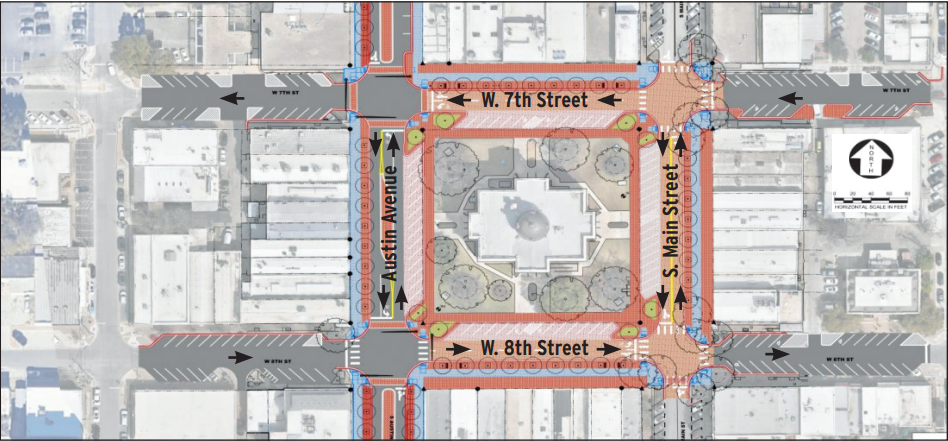
Last week at the Georgetown City Council workshop, council members got an update on the Austin Avenue Corridor and Downtown Conversion. The corridor portion is a much-needed project to better handle traffic along Austin Avenue and its intersections. The Downtown Conversion would be one of the largest city redesigns of the downtown Square since its original construction. As it stands now, the downtown plan has two parts.
First, it turns a three-block stretch of Seventh and Eighth streets between Church and Rock into one-way roads in opposing directions. Secondly, inside the Square, it eliminates parking on the business sides of Seventh, Eighth and Main streets and widens the sidewalks there to make more room for outdoor seating, product displays, and so on. As I listened to the presentation and watched the Power Point slides, I remembered another presentation made decades ago that was, in spirit if not size, much the same.
In the middle 1960s, the city folk in Waco made a presentation to Baylor students about their plans for using the Urban Renewal money that was then gushing out of Washington. They said they would buy the property around the city hall square, a larger version of our square, clear off the old buildings and sell the land for redevelopment. Next, they would convert five or six blocks of their Austin Avenue, which ran west out of the city square, into a pedestrian mall.
Students knew this area well, because the movie theaters were on or just off Austin Avenue as was much shopping. But the area had come under pressure from new retail development away from downtown. Lake Aire Mall, the first enclosed, air-conditioned shopping center, had opened a few years before and was popular. The downtown was in decline.
The planners gave a sort of pep talk illustrated by beautiful scenes of people strolling among planters and benches, and browsing the beautiful show windows of the new shops on the new mall. They finished the presentation and asked for questions
Right off, an angry girl, an iconoclast in the front row, jumped up and completely scorched the plan. It wouldn’t work, she said. People wouldn’t go there. It was a waste of money. The street would die, not revive. And so on. The city folk and planners were nice about it and said thanks. No one else objected.
I remember that girl, because what she predicted would happen, did happen. The pedestrian mall opened in 1970, but the business activity of only a few years before did not return, nor did new business develop. Yes, people could walk to the mall from nearby parking areas, but they didn’t. By the mid-1980s, the city finally admitted what everyone had known for years — the beautiful idea had failed. The mall was dismantled, the street re-opened to two-way traffic, and today the area is a lovely, tree-lined street — with on-street parking.
* * *
What brought the Waco story to mind is the current proposal that Georgetown remove half of the parking in the center of the Square and replace it with wider sidewalks.
It seems reasonable, at first glance, that we could cut parking spots from the center, because we’re replacing them with parking spots in the new garages — a one-for-one exchange. But is it really an even trade?
If we think of our own habits, we know that we don’t think that all parking spots are the same. Close is better than far. And there’s the rub; the current plan seems to assume that the parking spot trade is one-for-one, when in reality, it’s a trade of more convenient for less convenient.
Around the Square and one block off the Square, we have about 246 parking spots, not counting parking west of Austin Avenue. The current proposal cuts about 50 close-in spots from the business side of Seventh, Eighth and Main streets. People who would have parked in these places, will now hunt the side streets and take open spots there.
So we don’t really move those 50 cars from the center to the garages — we first move them to side streets. As a result, the side streets will likely have less available parking they do today.
Additionally, the plan would remove about half a dozen handicap spots. We’ll have to remove them permanently or insert them into the side streets, which further reduces the space for others there.
* * *
So far in the modern history of the downtown, changes have been gradual and incremental. The old sidewalks of uneven, concrete slabs were replaced by brick pavers. Building owners who fronted these new sidewalks paid a per-foot tax assessment until the sidewalk cost was paid off.
The corner pocket parks were built with a share of private and city money. If you look, you'll see plaques in the pavement of these parks recognizing the donors.
And the city executed one of the nicest changes when it traded a few parallel parking spots on the west side of Austin Avenue for a wider sidewalk there, an incremental change that has given much delight.
So it’s a puzzle: The Austin Avenue trade of parking for more sidewalk was small enough that unanticipated problems would likely be small problems that we could live with.
But who can predict what unintended consequences there might be if we trade 50 of the parking spots closest to businesses for three wider sidewalks? That’s not an incremental change.
And one-way streets? We know from experience that they can hurt business that front them. These may be too short for that to happen, but who knows?