
Warm and very wet June conditions have resulted in heavy plant growth and an explosion of various insect pests.
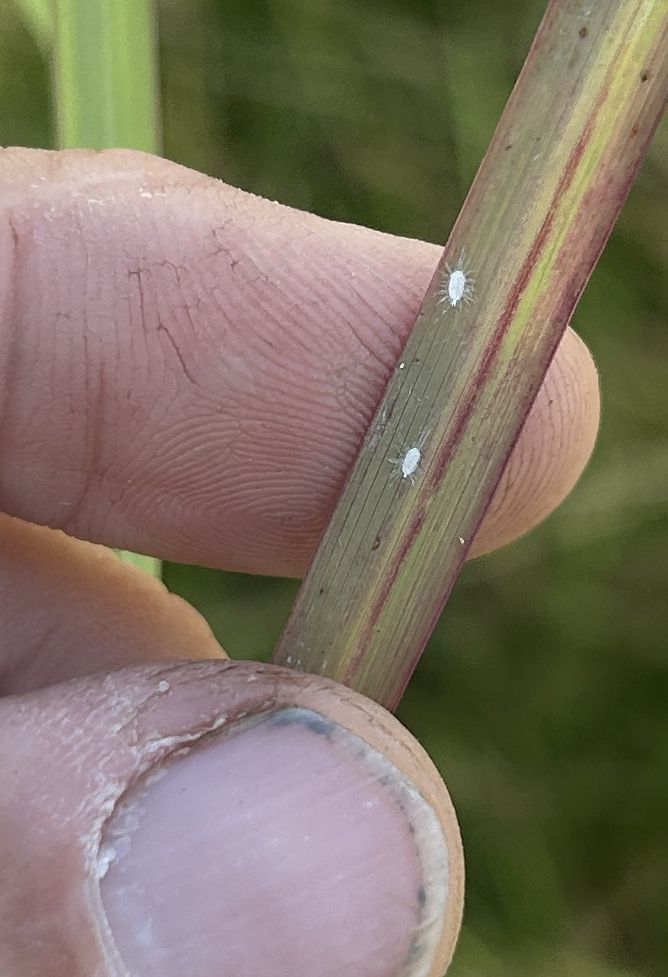
You may have already heard about New World screwworm impacting cattle in Texas, but another invasive pest, the Pasture Mealybug, has now been found on turf in Georgetown.
What was once considered a farmland issue has now invaded urban lawns. St. Augustine turfgrass is easily targeted by the Pasture Mealybug, which is protected by the thatch layer of the lawn
I discovered the Pasture Mealybug in a grassy area bordering a public parking area in Georgetown. It was remarkably easy to spot the diagnostic red/purple-colored blades of grass poisoned by toxins injected by the bug. I found a few bugs on my shoes after walking in the contaminated grass area. Clearly, this pest spreads quickly as it sticks and hitchhikes on shoes, clothing and mowing equipment.
AgriLife Extension entomologists first confirmed the pest in Texas in 2025. The insect has been confirmed in 70 Texas counties so far. The insect feeds on a wide range of native and improved warm-season grasses, including Bermuda grass, Bahia grass, bluestems, johnsongrass and other important forage species.
Immature mealybugs feed on plant sap and inject toxins that weaken plants, often resulting in a condition known as pasture dieback. In severe cases, fields can turn brown, thin dramatically or die outright. Pasture Mealybug is unusual in that it will kill the grass stand and affects grasses only.
How to stop it
• Thoroughly clean off your equipment and clothing before moving to other sites. Spray permethrin insecticide on your shoes/socks and lawn equipment. Permethrin will also control chiggers, itch mites and ticks too. Brush off your pets before leaving infested areas.
• Lawns may be treated with other registered insecticides that translocate well within the grass plant that kill the mealybug as it feeds. Reduce the thatch. Green leaf growth must be sufficient before spraying insecticide. Most importantly, use the least harmful insecticide to save the beneficials.
• A natural biological control predator called the Mealybug Destroyer looks like a regular mealybug, but is the larva of an Australian Lady Beetle. The Destroyer is beneficial and was originally imported to California from Australia to manage citrus mealybugs. This beneficial bug is small — about 2-3 times the size of aphids — and moves about quickly to capture and consume both aphids and mealybugs. I have watched these feeding on sorghum aphids. Mealybug destroyers can eat up to 250 aphids.
You can purchase mealybug destroyers yourself to develop your own home biological control program, but this shouldn’t be necessary as large populations of the destroyers occur naturally in our area.
When aphids and mealybug food sources appear, the population of destroyers will quickly increase. Unfortunately, sometimes when a new invasive pest arrives it may take a bit of time for predators to reach a high enough population.
Gary Pastushok is a Williamson County Horticulture Agent with the Texas A&M Agrilife Extension Office.