
PULLING H
AIR Linda Scarbrough
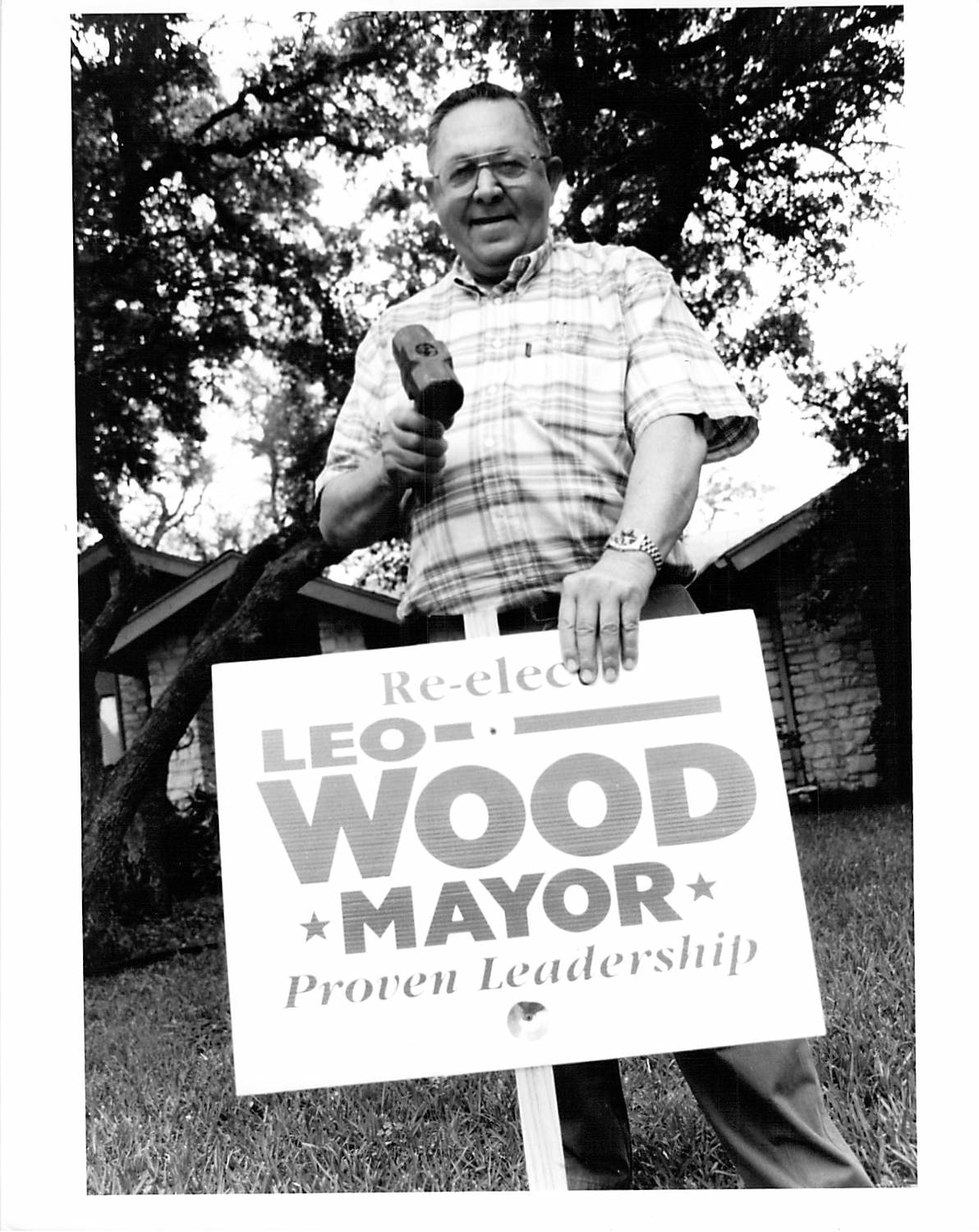
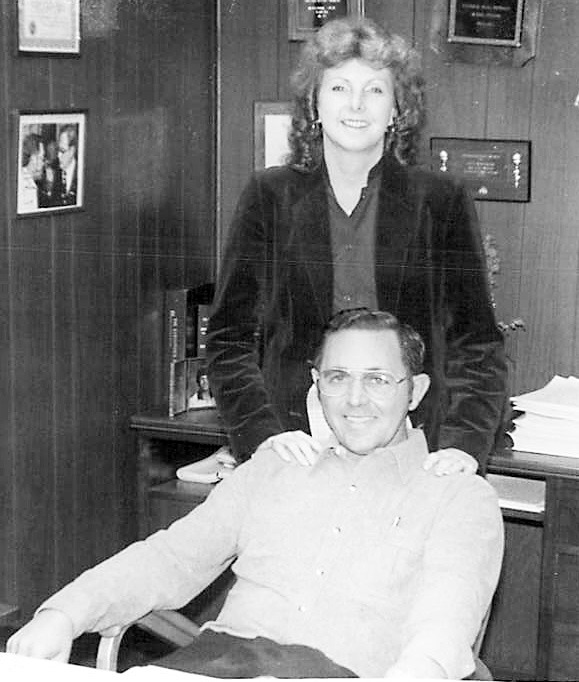
It seems impossible to fathom, but Leo Wood has departed from Georgetown. He died Sunday, October 2, after a physical decline that worsened after the death of Vivian, his wife of 60 years, last year.
Georgetown has prospered through the efforts of several exceptional leaders, living and deceased, who made great things happen. But I can think of vanishingly few people involved in city government who can compare to Leo in making a positive difference.
LeoWoodcametoGeorgetown in 1969 from Rosebud to become our city manager. The city was close to broke. A new family or business was cause for celebration, with the population barely inching past 6,000, even though Interstate 35 opened west of Georgetown in 1965, directly connecting us to Austin, Dallas and points beyond. There was no Lake Georgetown to serve as an amenity for development or as a source of water. The county courthouse and downtown square were run down and shabby.
Wood’s central job as city manager was to encourage growth and beef up city coffers. He would be helped by the 1972 arrival of a new Westinghouse plant with 800 jobs located a few miles south of Georgetown on I-35. Meanwhile, developer Bobby Stanton, backed by Georgetown Savings & Loan, built a new subdivision, Serenada Country Estates, west of the interstate, which became the largest collection of high-quality housing in the county that had been built in decades. Westinghouse’s executives, most having moved here from Pittsburgh, Pennsylvania, loved Serenada and, Wood said in 2000, became a major force for change in Georgetown.
Being Mr. Optimistic
Leo had one very special talent: people really liked him. He worked at it, I’m sure, but I think it was just Leo’s way, his personality. He was an eternal optimist, and people in Georgetown responded to his sunny point of view — a sort of down-home version of Ronald Reagan. Everybody knew Leo, and he knew everybody in town, especially in those early years. His knowledge of the community and of the people who lived here cut across social, business, race, religious and ethic lines, embracing every person, or as close to it as he could manage. He was everywhere, checking on everything, at all hours. If there was a water pipe break in the middle of the night, he was there, overseeing the fix. He made it his business to know everyone in the affected neighborhood, or to get to know them. He was a superb retail politician, even as city manager.
Another strength was his knowledge of infrastructure — not just the engineering, but projects’ impacts on human beings. In real time, he witnessed how I-35 changed Georgetown and Williamson County, and learned from it. He would draw the same kind of knowledge from watching two U.S. Corps of Engineers water projects (North Fork and Laneport dams) get built and Lake Georgetown and Granger Lake became realities.
Perhaps not surprisingly, he became a master at getting infrastructure grants — especially for transportation projects — from Texas and the federal government.
Thus, through his city manager years, from 1969 until 1985; his two terms as mayor of Georgetown during the 1990s; and for two more decades as a consultant to the City of Georgetown and other government entities, he championed and guided transportation projects that today most of us take for granted.
I will note one example: Texas State Highway 130, the toll road that splits from I-35 north of Georgetown, curves east around Round Rock and Austin; and connects with Interstate 10 east of San Antonio.
The highway, under other names, had been proposed and defeated several times over the course of decades; many people thought it would never be built. Leo thought differently. He made it his business to secure rights of way along the highway’s last proposed route, which did indeed become Toll 130.
“They called it Leo’s folly,” he said a couple of months ago, and laughed.
But he found money to pay for it so it cost the city almost nothing, he said.
That prescience will continue to benefit Georgetown for years to come.
Burnishing the Square
Leo Wood accomplished something else as city manager that many readers may not know: he aggressively supported the city’s first efforts to create a renaissance of lively businesses and beauty around the Courthouse Square and downtown business district.
The center of Georgetown was in a sad state. Most buildings were occupied, but business was slow. Few building owners had the money to invest heavily in their historic buildings.
In 1981, when Georgetown was chosen as one of a handful of Texas Main Street Project (now Main Street Program) cities, Leo needed no prodding to embrace preservation of our small town’s Victorian-era architecture. He started by hiring Linda Flory McCalla as the city’s first Main Street Project director, a brilliant move.
Buoyed by the prestige of Texas’s leading role in the National Trust for Historic Preservation program, McCalla’s distinguished work, and Leo’s behind-the-scenes cheerleading about the benefits of preservation, one building owner after another secured low-interest loans from locally owned banks for “facade work” on their structures — basically, making them beautiful based on their historic era. This was followed by a big beautification effort by the City of Georgetown: tree plantings, brick-like sidewalks and resting places, and benches all around the Square. A gorgeous restoration of the Williamson County Courthouse crowned the effort.
Today Georgetown proclaims itself as “The Most Beautiful Town Square in Texas” — and it’s a fact.
Without Leo’s full-fledged support of the Main Street Project in 1981, much of this could not have happened.
A seeing mind
Here is the big thing about Leo. He didn’t hold grudges — at least, not that I knew. Sometimes he miscalculated and got roundly criticized for it. Being in government, in public service, does not guarantee smooth sailing.
But Leo never gave up. He never stopped working to try to make things better.
When I last saw him in August at The Wesleyan’s Skilled Nursing facility, I knew he was in bad physical shape. I knew he had limited time. But aside from the wheelchair he sat in, the changes that had come to him were invisible. He had the same bright eyes, the same easy smile and sense of humor, the same clear-spokenness I had known since 1975, when I first interviewed him. He was absolutely Leo.
He told stories about his time as Georgetown’s city manager, and later, as mayor. Lots of stories. Lots of detail. I had not anticipated a long interview, so I had no notebook, no pen. I would bring them the next time, I thought.
Leo without work was hard to imagine, so I asked, Leo, are you working on any projects now?
Well, actually, yes, he said. But he wasn’t ready to talk about it. It wasn’t advanced to that point; he wanted to get it wrapped up before he talked about it. So sorry, but he couldn’t discuss.
Later, when I was gathering up my things to go, I tried again: “Can you give me just a hint about what your project’s about?”
“Can’t tell you that, but there should be an announcement after the first of the year,” he said. “I hope I live long enough.”
“Well of course you will,” I said. “I’ll be there for the announcement.”
As I turned to leave, Leo burst out, “We’ve got to get people across town!”