Water bills could go up across region if sale doesn’t happen, mayor says
Georgetown’s Water Utility serves about 74,000 water customers, 27,000 of whom live within an area that was once the Chisholm Trail Special Utility District located north of Georgetown and into Bell County.
The Chisholm Trail water territory was acquired by Georgetown about 12 years ago, when it included about 7,000 customers who were concerned about the rural utility’s water and infrastructure reliability. Georgetown Water Utility has served the area since.
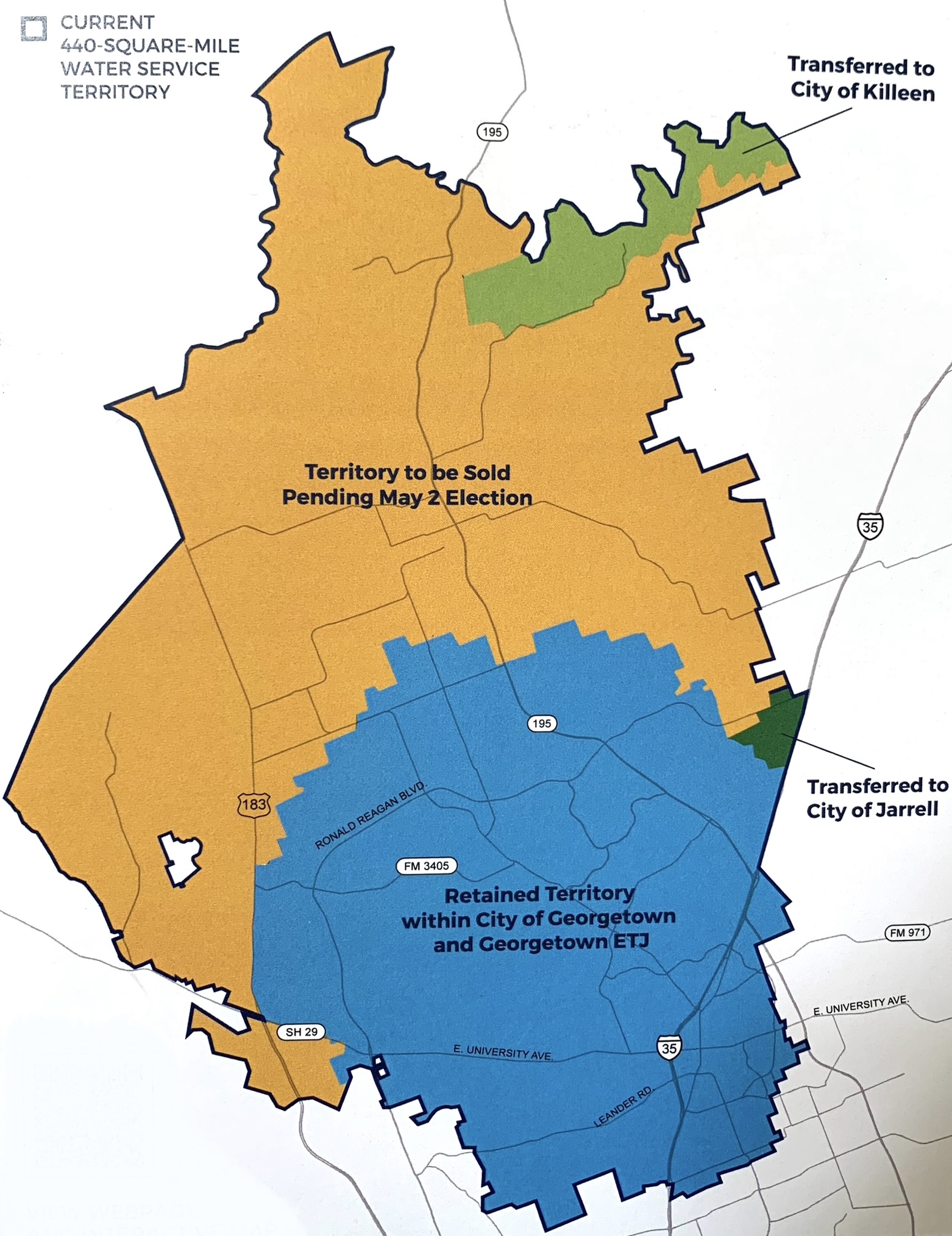
On May 2, Georgetown voters will decide whether or not Georgetown should sell most of the former Chisholm Trail water territory to a private company, National Utility Infrastructure, for about $60 million. The sold area would include about 10,000 customers, based on information provided by the city.
Selling the Certificate of Convenience and Necessity — or CCN — for this area would reduce the amount of water and infrastructure costs needed to sustain Georgetown’s water supply in the future.
City Manager David Morgan said the city is pursuing the sale because of population growth, not just in Georgetown’s city limits across the entire water territory.
“We’ve been working on water for a long time,” Mr. Morgan said. “Our growth assumptions that we had, we were planning on rapid growth. But, the exponential growth we started to see, it’s really everywhere, and there’s a lot of growth happening in this area that is considered for the sale.”
In recent years, Georgetown has pursued contracts to reserve groundwater from East Texas for future use. However, Mayor Josh Schroeder said having to secure water for a territory as large as Georgetown’s presents challenges.
With such a large water territory, Mr. Schroeder said it can also be difficult for a single utility to determine where to invest its infrastructure.
“We’re in a very dynamic water environment, and we don’t think that that’s the proper level of risk for a municipal-owned utility,” Mr. Schroeder said.
Because the water system has a “natural break” where the old Chisholm Trail water territory is, he said city staff explored a sale.
“We went and talked to the experts, and the experts said, ‘yeah, we think [someone would buy this,]’ ” Mayor Schroeder said.
He said voting for or against the sale will have a “massive financial impact” on utility bills. If the sale doesn’t go through, the city will have to adjust the “out-of-city” water rate to make it more expensive to accommodate for the infrastructure that will be added in the future.
“They’ll need 60,000 acrefeet of groundwater out there [in Chisholm Trail] versus the 40,000 that we need in [Georgetown],” Mr. Schroeder said. “If they remain part of our system, they’re going to have to pay more of that cost. There’s just no two ways about it.”
If approved, the city would continue to provide water to the entire area for up to 10 years while additional water is acquired and secured by the buyer. Mr. Morgan said it could “take a while to get done and to do responsibly.”
“We’re looking to make sure that our utility rate payers are taken care of and we want to make sure that the folks in the territory that we’re selling aren’t literally left high and dry,” Mr. Schroeder said.
Meet the buyers
Georgetown started looking for buyers last fall.
City staff approached the Cities of Killeen, Jarrell, Salado, Liberty Hill and Florence — which have some jurisdiction over areas located within the sale territory. The Cities of Killeen and Jarrell were the only takers.
The rest of the territory was put on the market to private utility companies, who would provide the water and infrastructure to support the area long-term.
When looking for a buyer, Mr. Morgan said the city looked less at the dollar amount, and more at a company’s experience and plan to provide water to the region.
“That’s our goal, for all this to be handled responsibly,” he said.
The city chose National Utility Infrastructure, a utility-providing subsidiary of Louisiana-based infrastructure private equity firm Bernard Capital Partners.
If approved by residents, National Utility Infrastructure will purchase the territory for about $60 million. The money would pay off debt associated with Georgetown infrastructure in the sold territory, Mr. Schroeder said. Any remaining funds would stay with Georgetown Water Utility.
“When you hear the Bernard Capital folks, they’re super excited,” he said. “They see the potential to serve this area and the growth potential here. When they talk about going out and doing a long term water deal, they’re looking at it like a private company.”
Georgetown and Chisholm Trail history
Chisholm Trail SUD initially operated independently to serve rural areas between North Georgetown up to Killeen.
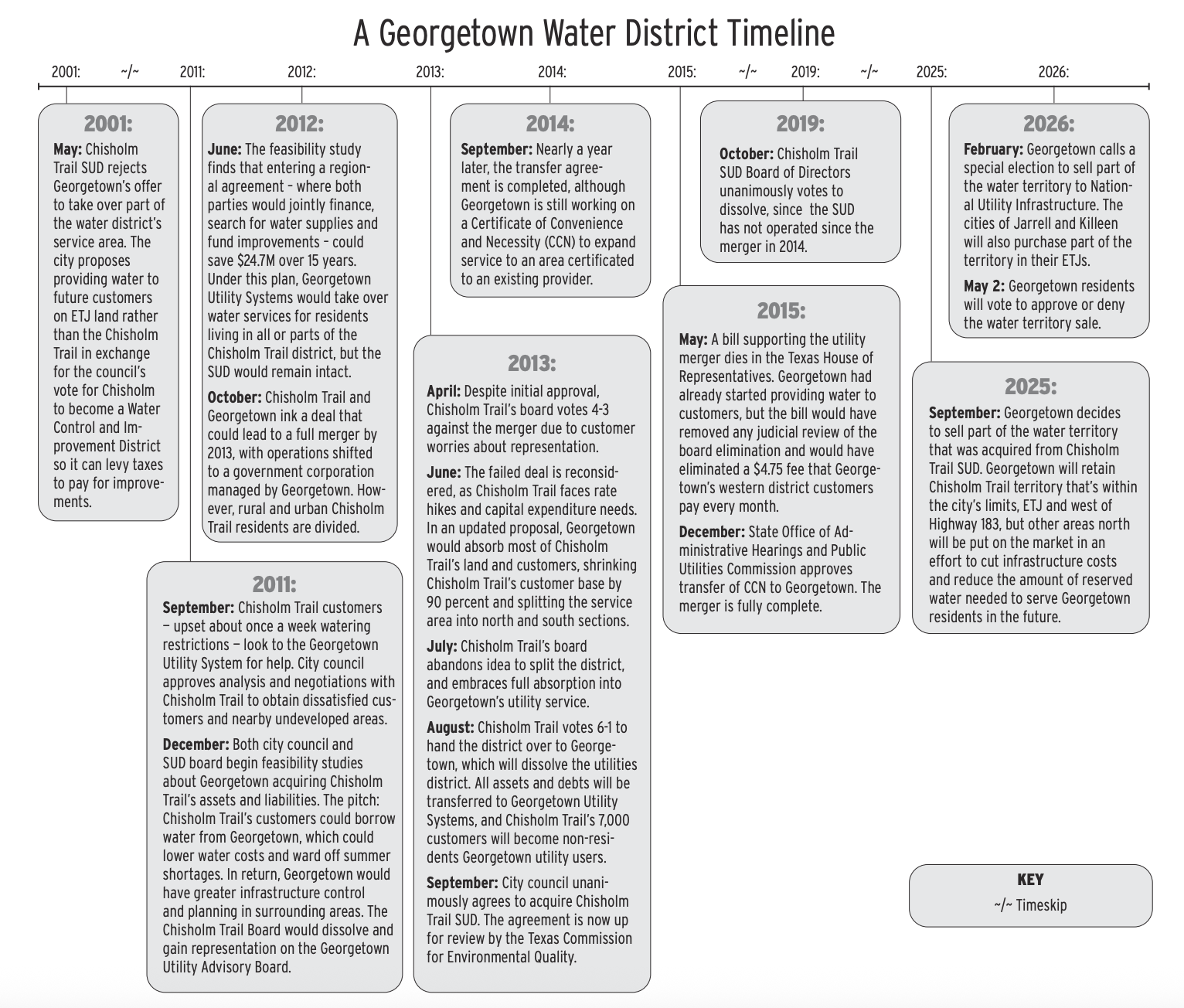
Discussions about a partnership between Georgetown and the SUD date back to 2001, but got serious around 2011, when SUD water users were upset about watering restrictions.
In 2014 — after three years of negotiations — Chisholm Trail’s assets and debt were transferred to Georgetown Utility Service.
Those negotiations predate Mayor Schroeder and Mr. Morgan’s times with the City of Georgetown, and a lot of the key players have since left. However, the two characterized why the proposition may have been appealing for the city at the time.
Adding Chisholm Trail SUD in 2014 — which only had about 7,000 customers at the time — gave Georgetown utility jurisdiction over most of its city limits and the majority of its extraterritorial jurisdiction. This meant more influence in the development of areas on the outskirts of Georgetown, access to water rights and easier future planning of what was then a slowgrowth, rural region.
Residential growth over the past 10 years, however, has changed how much it costs to serve the area and invest in its urbanization. The area now includes 27,000 customers, with more on the way.
“In 2011, the idea that someone was going to build a neighborhood of 5,000 homes outside any city’s jurisdiction — whenever they want, however they wanted, without asking any city or the county’s permission — was pretty far fetched,” Mr. Schroeder said.
Who gets what in a sale
With the proposed sale, Georgetown will retain parts of the Chisholm Trail area located within Georgetown’s city limits and extraterritorial jurisdiction, as well as a portion of the territory west of the ETJ to Highway 183. This includes about 16,900 customers.
National Utility Infrastructure would purchase the rest of the former Chisholm Trail service area, a little more than 10,000 customers.
The logistics of separating the territory is an “evolving process,” the mayor said. However, the goal is complete separation.
“Part of the analysis was based on our existing system and infrastructure, and just recognizing that there are more natural break points, separation points. That’s why the [dividing] line is where it is,” Mr. Morgan said.
However, the two systems could continue to work together, even with a successful sale, if things make “financial” or “engineering sense,” Mr. Schroeder said. He noted areas where Georgetown’s water system connects to Round Rock’s to the south, and Leander’s to the west.
Georgetown will not sell any of its water rights in a sale, Mr. Morgan said.
When Georgetown acquired Chisholm Trail SUD in 2014, the water rights of the former utility district went to the city. The city will maintain these water rights to continue serving Georgetown’s utility customers, specifically former Chisholm Trail users.
“These customers use more water than the city acquired with CTSUD, and rely on water that the city provides from other sources,” Aly Van Dyke, director of communications and public engagement said in an email. “Our estimates show those retained customers will fully exhaust the water supplied through the Chisholm acquisition, and become reliant on other city water sources, as early as 2031, which is why Georgetown is retaining those water rights.”
Impact of voting
Beyond the possible financial ramifications to Georgetown water customers, Mr. Schroeder said selling the territory is best for all parties in terms of representation.
Georgetown’s utilities are owned by the citizens and rates do not need approval from Texas’ Public Utility Commission.
This means that Georgetown Water Utility customers who are not Georgetown residents lack representation if they aren’t satisfied with service. However, if National Utility Infrastructure is the owner, property owners can voice concerns at the Public Utility Commission.
“If you’re a property owner, developer out in this area, I would, quite honestly, be much more excited [for NUI] than David Morgan and Josh Schroeder being in charge of this area,” Mr. Schroeder said. “I think that they’re much more likely to get service out there with a private, for-profit owner, than they are with the City of Georgetown controlling it.”
Early in-person voting runs from April 20-28 with Election Day on May 2. Only Georgetown residents can vote in the water territory propositions.
Voting locations can be found on the Williamson County website at www.wilcotx.gov/185/Elections. For additional information, including a Q&A with the city, you can find that here.