
Experts encourage awareness
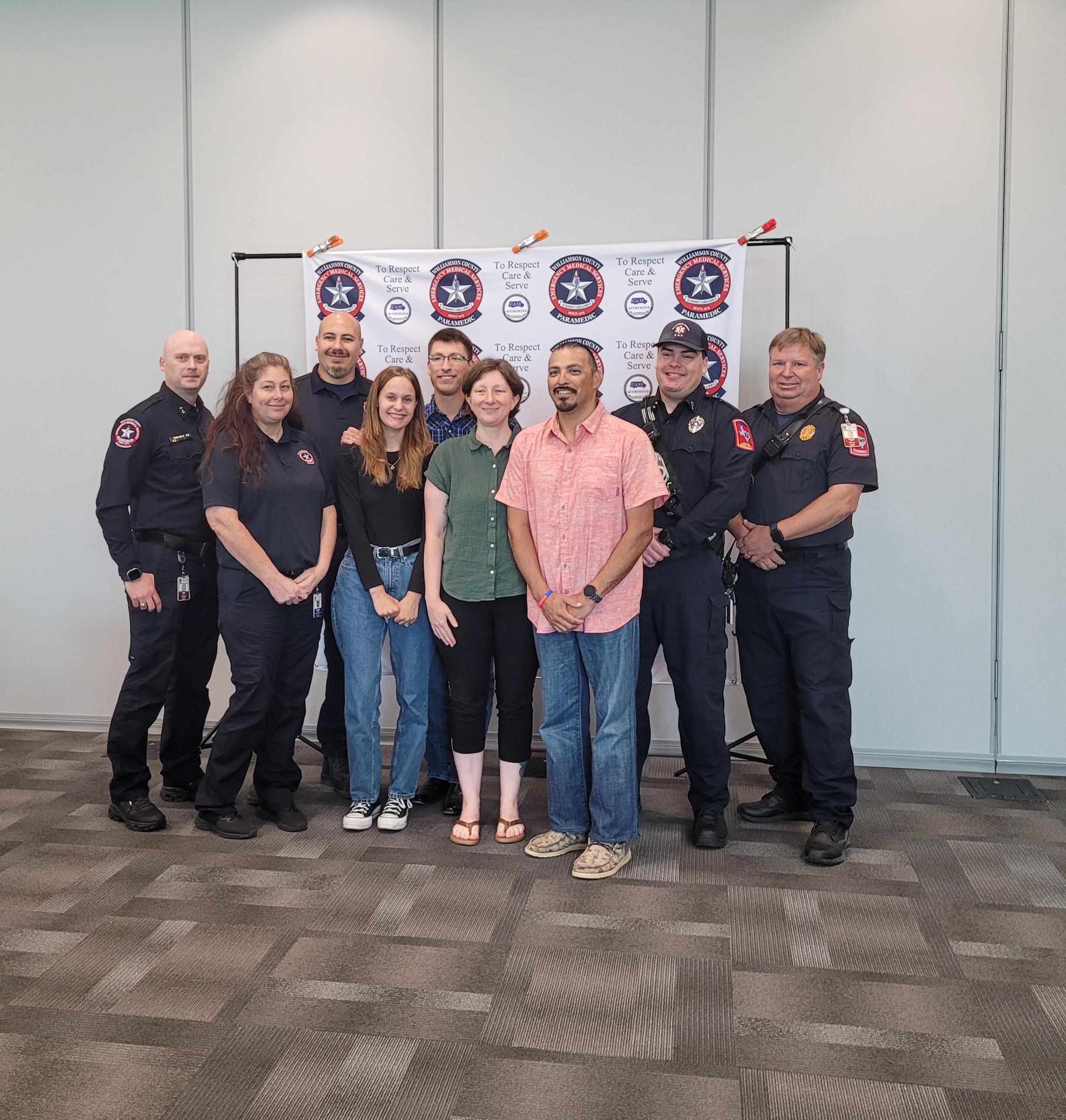
Jarrell resident Israel Chavez described his lifestyle as "semi-active." As a cabinet inspector for new home construction, the 43-year-old also logged an additional 10 to 15 miles daily on a stationary bike to manage his Type 2 diabetes.
“I’m not out there running marathons or anything like that,” he said. “But I also wasn't just like a couch potato, because I’m dealing with Type 2 diabetes. Trying to keep that under control, exercise helped me.”
Everything seemed fine until Mr. Chavez collapsed on his lawn from cardiac arrest on March 1. His son, Jaden, said he showed no symptoms and was in the middle of a conversation when he suddenly fell. Jaden called 911 and began administering cardiopulmonary resuscitation, or CPR, with guidance from the emergency dispatcher.
“I called 911 pretty much immediately, because we saw him fall,” Jaden recalled. “It was a sudden cardiac arrest. He pretty much flat-lined in our yard.”
June is CPR Awareness Month, and Williamson County Emergency Medical Services, Ascension Seton Williamson and St. David’s Georgetown are using the opportunity to emphasize the importance of CPR training.
Cardiac arrest occurs when the heart suddenly and unexpectedly stops beating, according to the Centers of Disease Control and Prevention.
"CPR dose save lives." ~ Israel Chavez, a cardiac arrest survivor.
Unlike a heart attack, cardiac arrest stops blood flow to the body, which can damage critical organs — including the liver, kidneys, limbs, muscles and especially the brain — according to Dr. Abhijeet Koli, a cardiologist at St. David’s Georgetown Hospital.
Dr. Koli said Georgetown residents benefit from access to parks and walkable neighborhoods, which help support heart health. However, the city’s older population means a higher risk of cardiac events.
He said that studies show for every minute that CPR is not performed, the patient’s survival rate decreases about 10 percent.
“We have done studies that show that the vast majority of success, the number one factor to make sure that you’re walking out of the hospital like nothing happened, is how quickly you do CPR,” Dr. Koli said. “That is extremely important.”
For Israel Chavez, Wilco EMS arrived five minutes after the initial call.
“If you think about that, if his son didn’t do CPR, it’s a coin flip at that point,” said Seth West, lieutenant for Wilco EMS, who responded to the call that day. “We don’t know what damage has occurred until a person wakes up.
“The fact that Israel is doing extremely well is awesome. I attribute everything to his son, because EMS can do a lot, but unless people do bystander CPR, what we can do is nowhere near as effective.”
The EMS crew transported Israel to Ascension Seton Williamson in Round Rock, where a specialized cardio lab team took over his care. Carleen Merola, critical care nursing director at Ascension Seton Williamson, said Mr. Chavez was provided with ECMO to help him recover.
Ms. Merola explained that extracorporeal membrane oxygenation, or ECMO, is a procedure that temporarily replaces the function of the heart and lungs, allowing the organs to rest.
In her 17 years as an emergency nurse, Ms. Merola said she has seen this type of recovery only 10 times. She credited the outcome to "perfect synergy" — Jaden’s quick action, effective CPR, and advanced care.
“This collaborative approach significantly enhances the likelihood that an individual suffering cardiac arrest will not only survive the initial event but also recover sufficiently to be discharged from the hospital, regaining their life and functional independence,” she said.
Now, Mr. Chavez is continuing his recovery and working on both his physical and mental health. He hopes to join a peer support group to process the experience.
“Can I get into a stressful situation and then get myself out of it without losing my sense, my center?” he asked himself. “But since then, I’ve been doing really well. I’ve had plenty of opportunities to talk about, but I’ve been busy. Haven't had a lot of downtime. So I think the family has been very helpful in that. This recovery, however good or bad it is, is still a recovery, and I’m still here.”
After his survival, Mr. Chavez and his wife enrolled in a CPR class offered by the county. Both Israel and Jaden urged others to do the same.
“I didn’t know how to do CPR before this,” Jaden said. “I’ve never taken a class. We realized after the fact that it was so important to his recovery that without it, he may not be here today.”
Williamson County EMS will host a Take10 in the Park event Thursday, June 12, from 9-11 a.m. at the pavilion next to the Quarry Splash Pad in Southwest Williamson County Regional Park, 3005 County Road 175, Leander.
The free, family-friendly event offers a brief, hands-on introduction to compression-only CPR. The Take10 program teaches bystanders to act during the critical first minutes of a cardiac emergency.
“This is exactly why learning CPR matters,” Mr. West said. “Cardiac arrest can happen anywhere. Every second counts, and what bystanders do in those first moments can determine the outcome.”
Dr. Koli said quality CPR requires pushing hard and fast — around 100 beats per minute. To improve heart health, he recommends 30 to 40 minutes of moderate physical activity daily.
“What I like to tell my patients is that, if you’re undergoing a casual stroll where you can have a conversation with your neighbor as you’re walking, you have to pick up the pace,” he said. “That is what ‘moderate’ tends to be. For people who are in better physical shape, obviously, they can do all of it, but very easily push yourself a little bit more.”
For more information about Take10 or other Public Education opportunities from Wilco EMS, residents can visit www.wilcotx.gov/353/Take10-CPR.
“At the end of the day, you have the knowledge that you know how to do something that could potentially save your loved ones life or a stranger who has loved ones,” Mr. Chavez said. “So, I think that’s why it’s important to know CPR, to get the word out that CPR does save lives.”