
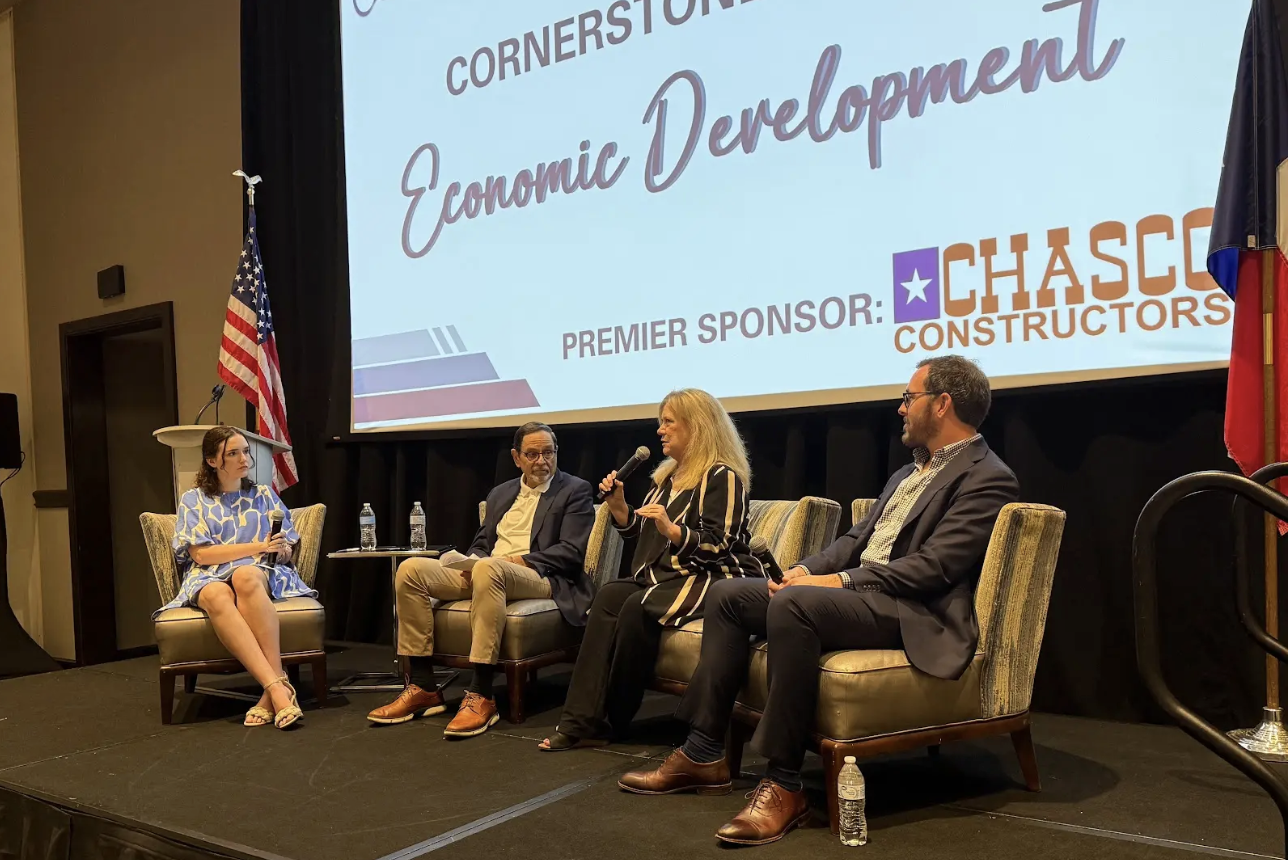
State and local economic development leaders gathered June 25 to discuss Georgetown’s rapid growth, expanding manufacturing sector and long-term workforce needs during a Georgetown Chamber of Commerce luncheon at the Sheraton Hotel.
The panel was moderated by Kaitlyn Wilkes, the city reporter for the Sun, and featured Dave Porter, the executive director of Williamson County's Economic Development Partnership; Cameron Goodman, the economic development director of Georgetown; and Janie Havel, the North and Central Texas regional representative for Gov. Greg Abbott in Economic Development and Tourism.
“The county hired a consultant to determine what the county will look like at the end of this century. I don’t know of any other county that does this, but it was fascinating,” Mr. Porter said. “In 74 years, there will be 3 million people here. [...] In 10 years, Williamson County’s population is supposed to be between a million and 1.1 million.”
Mr. Goodman explained planning for economic development growth requires extensive planning, including putting in water infrastructure, utilities, city services and public safety services. He described this as a team effort between the city departments.
Preparing advanced manufacturing growth
Recently, Georgetown has benefited tremendously from manufacturing companies like Samsung and Tesla locating nearby. Mr. Goodman highlighted two electronics companies from Taiwan, Pegatron and Compal Electronics, that are opening manufacturing plants in Georgetown. Mr. Goodman said other electronics companies in Taiwan are also looking to Georgetown as a potential site. Around 90 percent of the workforce will be local hires, Mr. Porter estimated.
“I think our region's really emerged as one of those premier areas for advanced manufacturing, not necessarily just normal manufacturing— it's a good mix of high-wage jobs with high-trained individuals too,” Mr. Goodman said.
He noted that the Future Ready Complex at GISD is also helping prepare high school students to enter trade professions.
“We continue to outperform many of the counties, not only in Texas, but around the US,” Mr. Porter said. “Georgetown continues to win [development] project after project,”
Samsung will have a full production team by the end of this year, Mr. Porter said. The company also has plans to build eight or nine semiconductor facilities in Taylor.
“Our demographics in Williamson County is perfect for advanced manufacturing,” Mr. Porter said. “Advanced manufacturing wants highly skilled labor, highly educated labor, and Williamson County meets both of those qualifications.”
When new manufacturing companies come to Georgetown, he said they offset the imprint they create.
“The growth pays for growth,” Mr. Goodman said. “When a large electric user comes in, we require them to pay 100 percent of the cost that they're going to be using, we don't pass those on to other ratepayers. We have impact fees for traffic, for water, so those companies are basically paying for their pro rata share of the impact that they're creating.”
Earlier this year, the city began a study on the future water needs of Williamson County, Mr. Porter added. Mr. Goodman said the reason Georgetown is attractive to companies is because it can build the necessary utilities in six to nine months. Other cities may take two years to get the proper utilities in place, he said.
Creating trade job opportunities and attractive retail developments
The city is focused on creating career opportunities for students in Georgetown ISD and the surrounding communities, Mr. Goodman said. The city has also partnered with Austin Community College and Texas State Technical College.
“[Students can] go and earn 125,000 $150,000 on a lot of these jobs and have a great career, live in Georgetown, support a family.”
The county requires new manufacturing companies to offer between 10 to 24 internships or apprenticeships for high school students, Mr. Porter noted.
In addition to manufacturing projects, Georgetown is also focusing on bringing more retail development, Mr. Goodman said.
“We want to ensure Georgetown continues to be a really good place to live for people— that they don't have to drive to Round Rock or further south to do their shopping,” Mr. Goodman said.
Examples of this include the Southwestern 560 Project, the various retail developments on SH 29, Williams Drive and the east side of Georgetown.
“We're putting a big focus on bringing those quality of life amenities,” Mr. Goodman said. “We're also seeing some office jobs. I think that the TNL office project coming to Georgetown, [will bring] 250 jobs near our downtown.”
In Williamson County, right now, there’s more than 15,000 business entities, Mr. Porter said.
“When you look historically at job growth, 75 to 80 percent of all job growth will occur from companies already here,” he said.
Mr. Goodman said the city is partnering with the Georgetown Chamber to prop up small, local businesses. The Georgetown Chamber is one of the largest local chambers in Central Texas, showing a well connected small business community.
What Greg Abbott’s office has been doing
Janie Havel, the North and Central Texas regional representative for Gov. Greg Abbott in Economic Development and Tourism, was also on the panel.
She brought up Gov. Abbott's five-year economic development plan, entitled “Bigger. Better. Texas.” Part of the plan focuses on the growth potential of 10 economic regions, including Williamson County.
“We have about four over 400 active projects that are considering location in Texas right now, and I would say about half of those are in manufacturing,” she said. “There are also [significant projects in] advanced aviation and traditional manufacturing.
The governor launched the Texas Jobs Council, which will provide a report on areas that have the greatest opportunity for executive orders in order to “alleviate some of the red tape or regulations that are involved in education”, she said.
“We have an organization within the office of the Governor of the Texas Workforce Investment Council, and they coordinate with the Texas Education Agency and with the legislature, as well as with TWC, to make sure that we have a plan every five years on making sure our high school students and college students are workforce ready.”