
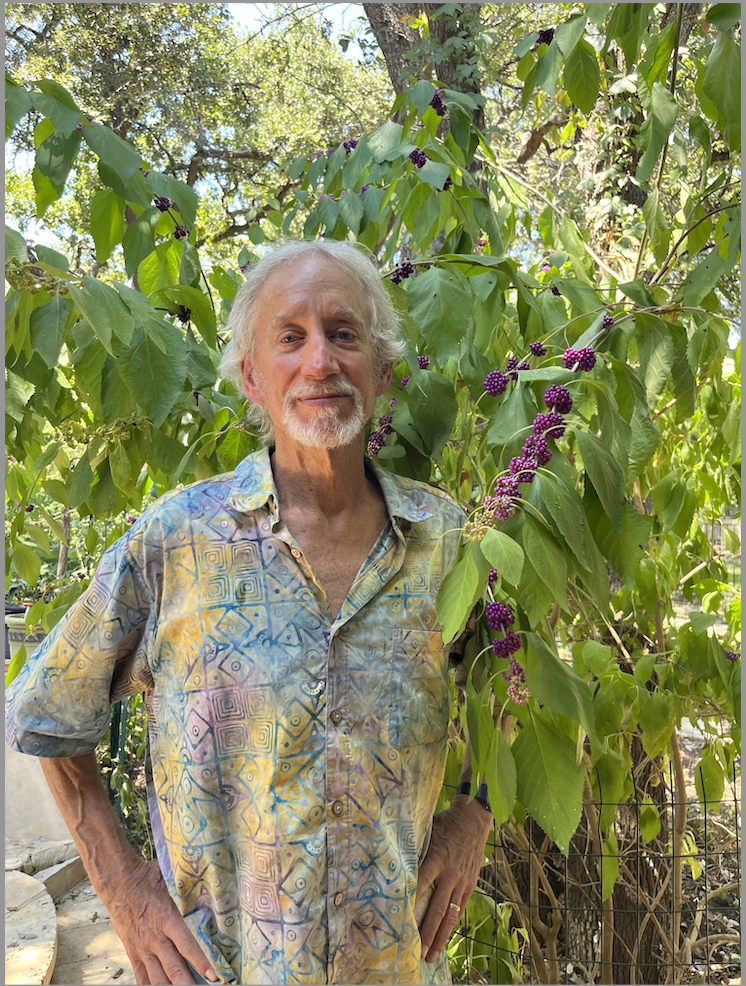

Sun City Resident Martin Byhower and his native garden will be featured on the Central Texas Gardener show on PBS Station KRLU on October 19 at noon and 4 p.m. and on October 20 at 9 a.m.
The Central Texas Gardener show is the longest running show on PBS. The production team spend almost two full days interviewing Mr. Byhower, who has more than 150 native Texas plant species growing in his yard.
“People think that if something just grows, it’s a weed,” Mr. Byhower said. “These are all ‘volunteers’ which are what we call plants that come up on their own. Most people, when something volunteers and think ‘oh that’s a weed’ and pull it out. I always say: ‘When in doubt, don’t pull it out.”
He said he believes that the plants in his yard — which require little water — are the answer to water rationing regulations across Central Texas. He said having native plants is also crucial for native animal species that rely on certain plants. It is particularly important to save keystone species, which support a large number of other species, he said. Although these plants are suitable for the harsh summer climate, they have not always been suitable according to HOA standards.
“The way that most people manage their yards is against wildlife rather than for wildlife,” Mr. Byhower said. “If wildlife is going to make it, it’s going to have to be in our yards because so much habitat is being lost. The planet is changing.”
Mr. Byhower tends to his yard in a way that supports natural species. He allows the dead leaves that fall from his oak trees to stay in the firebed so that the birds have caterpillars to eat. He even has a small dead tree in a flowerbed near his home.
“Dead trees are as powerful as live ones. But what happens when a tree dies?” Mr. Byhower rhetorically asked. “People usually cut it down. But the dead oak tree [as a keystone species], has all sorts of critters in it that the woodpeckers and other things need. If we didn’t have woodpeckers, then chickadees and other birds wouldn’t be here. Woodpeckers make the holes that other birds nest in. So [woodpeckers are] a keystone species too.”
For the last eight years, Mr. Byhower has been a professional landscape architect and a birdwatching guide. However, he has been a nature educator for far longer. He was a middle school science teacher in California for 35 years before moving to Texas.
Mr. Byhower said he chose to move to Texas from California nine years ago because it is the second most biodiverse state. Upon moving here, he said that he was like ‘a kid in a candy store’ discovering all the Texas plants. Sun City was a prime destination, because the original developer, Del Webb, chose to build around the old oak trees. This left him multiple tall oak trees in his yard
“A landscape like this with a lot of green and trees is good for your soul,” Mr. Byhower said. “People are much less depressed in a place like this. It’s very calming and soothing and meditative and healthy.
“I have to get out and get my hands dirty everyday, personally that’s my form of meditation.”
Mr. Byhower highlighted a few of his favorite species. He said that horseherb or sedge — plants that are oftentimes considered a weed — should be used as ground cover instead of grass. It can grow in the sun or the shade and requires very little water. His yaupon trees have leaves that he dries and makes tea with. He pickles his chile pequin — which is the official native chile of Texas. The sub-shrub’s red berries are spicy when eaten and can be pickled. Birds, who don’t taste spiciness, eat the berries and drop the seed in other places.
Instead of using insecticide, he has planted American beautyberry trees to repel insects. The leaves, he said, are as powerful as deet when rubbed on the skin. The purple berries on the plant are a treat for the birds in his yard.
As a part of constructing his personal sanctuary, Mr. Byhower has a bird watching set up located behind his lagoon shaped pool. There is a small house and a fresh water bird bath that is hooked up to a small hose.
“Birds like fresh flowing water,” he explained while pulling up an app on his phone that plays live footage from a camera inside his birdhouse. “Three or four billion birds that used to be [in America] in the 1970s and 1980s aren’t here anymore. My goal is to help people do what they can by sustaining what we still have.”
Mr. Byhower said he just discovered that his great great grandfather was the first landscape architect in Holland. His grandma was a farmer and he just found a third cousin, who lives in Maine, who manages a huge forest preserve. He believes that the passion for preserving nature has been passed down through his family.
Mr. Byhower writes the monthly gardening column for Sun City in Sun Rays Magazine and also leads a bird walk twice a month for the Sun City Nature Club. He will be offering a garden tour for the club in October. If interested, email him at avitropic@sbcglobal.net.