
Come pay tribute August 2
First Lieutenant Charles Woodruff McCook
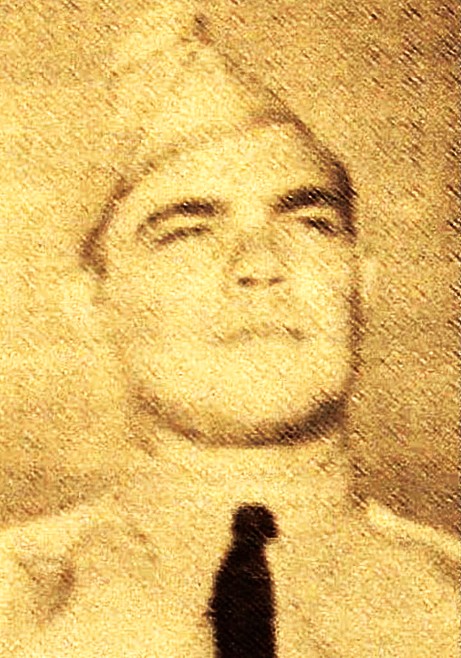
Never is an incredibly strong word. Never is an infinitely long time. Yet, after 82 years, First Lieutenant Charles Woodruff McCook’s homecoming has only been delayed. Thanks to scientific minds and patriotic hearts, it will no longer be denied.
Friends and family called him Woody. He was only 23 when killed in combat, during the deadliest war the world has ever known.
McCook died while leading a World War II bombing raid over Burma. He died after taking evasive action that saved the lives of two other soldiers. With his earthly remains finally identified, First Lieutenant McCook is finally coming home.
He will rest with his parents and other loved ones at Georgetown’s IOOF Cemetery. It’s so close to East Tenth Street, where he lived his childhood days. So close to Southwestern University, where he studied and his father worked.
On Saturday, August 2, a memorial procession will leave Veterans of Foreign Wars Post 8587, 1000 North College Street, at approximately 10:15 a.m. Traffic at intersections will be stopped as it proceeds to the cemetery, Post 8587 Senior Vice Commander John McCleskey said.
The procession will travel south on College Street, west on Eighth Street and around the Square. It will continue down Main Street, turn onto University Avenue and proceed through campus along Southwestern Boulevard before reaching the cemetery.
“We are truly honored to assist in any way we can to bring this veteran home,” Police Chief Cory Tchida stated. “He has been gone too long.”
“People can line up along the route,” Mr. McCleskey said. “Anywhere along College Street, Eighth Street – specifically, the Square – and then up and down University Avenue to Southwestern.”
After 82 years, chances are no one who knew Woody McCook, in life, will be on hand to give him one last salute, as he travels those last miles to his rest. But that doesn’t matter. It doesn’t matter at all.
“We invite the entire community to line the procession route and help us show the hero’s welcome he has always deserved,” Mr. McCleskey said.
Andy Vaughn, a longtime Georgetown resident and Army veteran who served in Vietnam, agreed.
“With respect and honor, as it should be,” Mr. Vaughn said, “It doesn’t matter if it’s six months or 82 years.”
Marine Corps veteran Ercel Brashear, who also served in Vietnam, added six words that are more than just words to anyone who has seen combat: “No man will be left behind.”
The 'Flying McCooks'
A military website lists Woody McCook’s birthdate as May 5, 1920. He was born in Louisiana, where his mother had grown up.
He was born into a clan of aviation enthusiasts known in local lore as the “Flying McCook Family.” He and brother Joe learned to fly at Southwestern’s aviation field, which another family member ran.
Woody was the son of I.J. (known as “Danny”) and Mayme Lee (known as “Mammaw”) McCook. A 1938 Georgetown telephone directory says the family’s home was at 1157 East 10th Street.
The family was held in high regard, as Sun co-owner and co-publisher Linda Scarbrough recalls.
“Mammaw and Danny were a third set of grandparents to me,” she said. “My Dad, Don Scarbrough, loved them dearly. I.J. was Southwestern’s vice president and treasurer and Mammaw put on elegant small dinners to raise funds for SU when the school was flat broke. Mr. McCook did more than anyone, other than Congressman Lyndon Johnson, to keep the university afloat during hard times, my Dad always said.”
Woody and Joe loved flying in blue skies and wide-open spaces, but their earthbound world was in a tightly knit small town that according to the 1940 U.S. Census numbered only 3,600 souls. That 1938 phonebook — with its two-digit number assigned to the McCook household — contains only 10 pages, including listings for Jonah, Weir and Pflugerville.
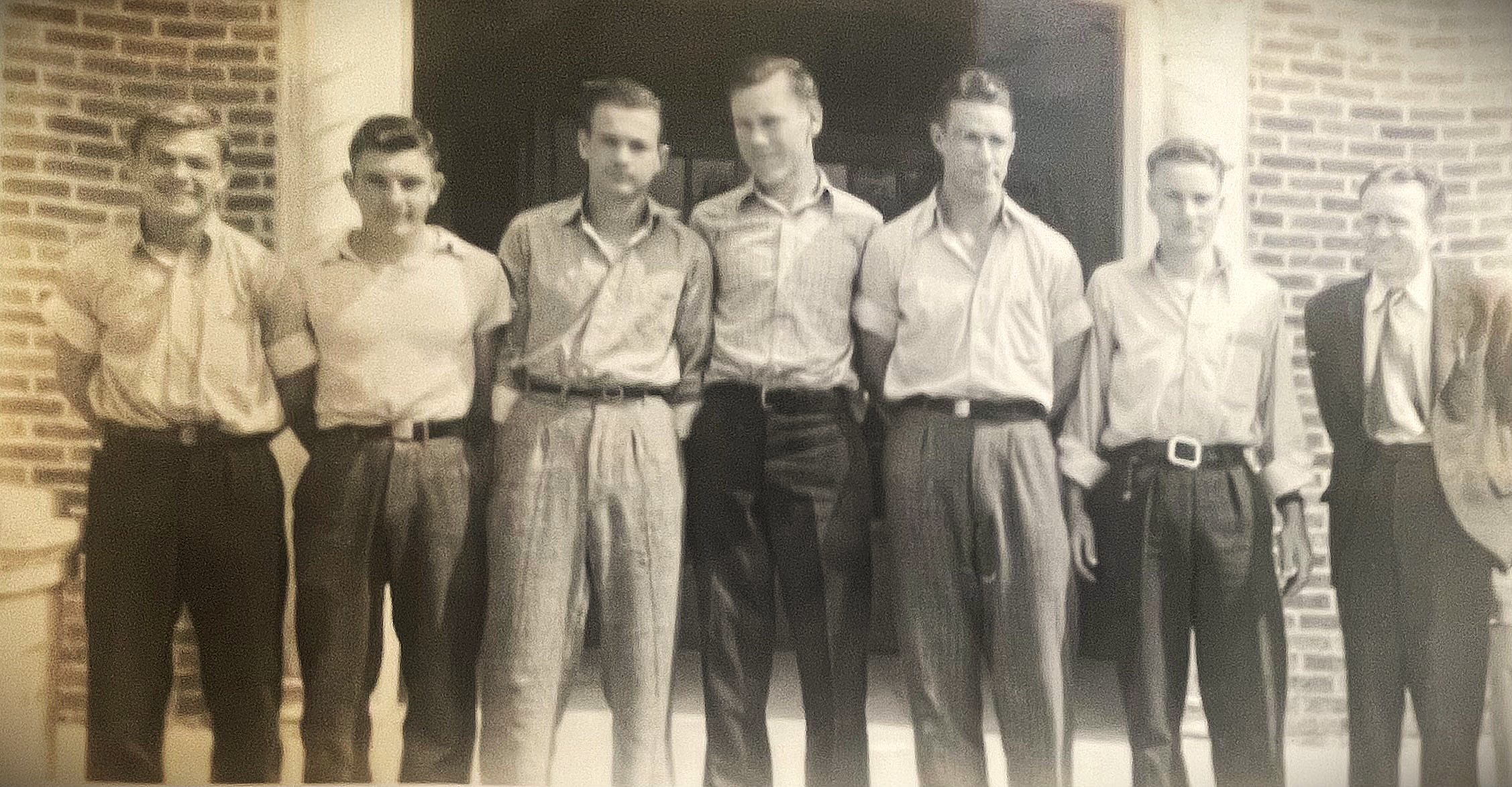
In 1938, Woody graduated from what was then Georgetown High School – now the Hammerlun Center for Leadership and Learning – at 507 East University Avenue.
The future First Lieutenant played football for the Eagles. Georgetown High’s 1938 yearbook has him listed as “Woodruff McCook,” there in an 11-man team photo. He’s seated in the front row — looking freshly scrubbed and with shirtsleeves rolled up to the elbows — with brother Joe by his side. Woody scored a touchdown in a win over Thorndale, and another one in a loss to Taylor.
An alphabetical listing of Georgetown’s 54 graduating seniors, Class of 1937-38, describes Charles Woodruff McCook as “The boy who can take it.”
America goes to war
People called it the “Great War.” Sometimes the “World War.” It didn’t have a Roman numeral attached during the four years of fighting. That would come later. U.S. involvement, from 1917-18, resulted in the loss of about 116,000 American lives. Combat – and a global influenza pandemic – took their tolls. When it was over and the Doughboys came home, most Americans wanted nothing more to do with wars on foreign soils.
All that changed, with Japan’s December 7, 1941 attack on the U.S. Pacific Fleet at Pearl Harbor, Hawaii. More than 2,400 Americans were killed and more than another 1,000 wounded. Three battleships and close to 200 aircraft were destroyed. Isolationism was no longer an option.
Woody and Joe each got into the fight. Both men were pilots. Woody, stationed in South Asia, flew B-25 bombers. Joe piloted C-47s, the military version of DC-3s.
Woody entered military service after graduating from Southwestern University in 1941 with a bachelor’s degree in business administration.
He earned his wings early in 1942 and quickly proved himself worthy of Uncle Sam’s investment in his training. Eventually rising to the rank of First Lieutenant, Woody McCook received both the Air Medal and Distinguished Flying Cross for his work dropping supplies to allied forces battling in the Pacific.
The fatal mission
The going had been tough. It would continue to be tough and at times get tougher. In 1943 D-Day, the Battle of the Bulge and Iwo Jima all lay ahead.
But in 1943 things were starting to look up — for Allies in both Europe and the Pacific, as well as for loved ones yearning for them across miles of oceans.
The 1943 homefront saw Oklahoma! open on Broadway and Casablanca playing in movie theaters. On radios and record players, Bing Crosby sang the soldiers’ bittersweet lament, I’ll be Home for Christmas.
In 1943, General George Patton was leading U.S. soldiers in the invasion of Sicily. On the Eastern front, Soviet allies beat back the Germans at Stalingrad. Each campaign cost many lives.
First Lieutenant McCook himself paid the ultimate price on August 3, 1943. His B-25 crashed during a low-altitude strafing and bombing raid in Burma, a British colony Japan had invaded. It’s been independent since 1948 and is now known as Myanmar.
McCook flew the plane. At 23, he was second-youngest in the six-man crew. A gunner, Sergeant John Earl Leisure Jr., was, at all of 28, the group’s old man. Other crew members included co-pilot Nathaniel Lee Hightower Jr., navigator Henry J. Carlin and turret gunner Sidney Burke.
Their B-25 was to be the last in and last out, behind two other planes in a bombing raid on a dam.
Leisure and Technical Sergeant John Boyd— a 24-year-old radio operator and tail gunner — were able to parachute out after enemy anti-aircraft fire hit the plane. Leisure and Boyd were both captured and held as prisoners of war. Leisure died in a POW camp in 1944.
Boyd later wrote a book, Tenko! Rangoon Jail, about his 21 months as a POW. Tenko is a Japanese term that literally means “changing direction.” It has also stood for “ideological conversion,” and it’s easy enough to infer that phrase is a euphemism for torture.
Boyd’s co-author, Gary Garth, describes the mission the six-man crew was on when they took off from India: “It was called skip bombing, a maneuver that required the twin-engine B-25 to make a straight-line, low-level approach near the tree top level. This allowed the plane to ‘slide’ into the target. It also made the plane an easy target for anti-aircraft fire.”
The first two planes in the raid dropped their loads without incident. McCook and his crew were not so lucky.
Mr. McCleskey, from the VFW, said McCook had the B-25 only 300 to 500 feet above ground when it was hit. At that low height, a parachute would not have enough time to slow the fast – and likely fatal – descent of any man depending upon it.
“His fuel line gets hit. His controls had been hit,” Mr. McCleskey said. “McCook was able to take the plane to above 1,000 feet and his tail gunner (Boyd, as well as gunner John Leisure) bailed out.
“He knew he was gonna crash,” Mr. McCleskey said. “He made a decision in the moment. This guy was a hero.”
The news hits home
The Williamson County Sun’s front page on August 20, 1943, carried the headline: “ ‘Woodie’ McCook reported missing in Asiatic Zone – Parents receive word Monday from War Department.”
From the Sun’s accompanying story: “Wherever Woodie McCook was, his personality and good nature immediately won him friends.
“His host of Georgetown friends, await alike with his parents and brothers, for further word announcing he is uninjured and safe somewhere in his field of operation.”
Further words such as those never came. Yet the world doesn’t stop for anybody’s personal loss. As the Sun also reported, on that 1943 front page: Congressman Lyndon B. Johnson was scheduled to speak at Southwestern, a War Bond rally was coming to House Park in Austin, Georgetown High School had hired a new football coach and classes would start up again September 13. For most, in Georgetown, the regular rhythms of life went on.
But for the McCook family, there on East 10th Street, nothing would ever be the same.
Linda Scarbrough — best friends with Joe McCook’s daughter, Susan — was often at their home. Susan was Woody’s niece.
“There was a formal portrait of him, in uniform if I remember correctly, in their den, and when the subject of his death came up Mammaw always started weeping …”
Leave no one behind
In Woody McCook’s time the American Graves Registration Service (now known as “Mortuary Affairs”) was what they called the military organization responsible for finding, identifying and burying deceased service members. It’s work, no matter how gruesome and stressful, continues to this day.
In 1947, those tasked with this grim assignment found a burial site outside the Burmese village of Kyunpopin. Local residents told them it held remains from an American plane crash in 1943.
These remains were taken to Hawaii, interred with other “unknown” bodies — or what was left of what once had been bodies — at the National Memorial Cemetery of the Pacific in Honolulu.
The site is better known by its nickname, “The Punchbowl,” so called because it’s inside a bowl-shaped crater formed by an ancient volcano blast. The Hawaiian name for this crater, Puowaina, translates to “Hill of Sacrifice.”
In 1947, the technology didn’t exist for identifying First Lieutenant McCook and the Punchbowl’s other unknowns.
Mr. McCleskey — the VFW man who’s spearheading the August 2 tribute — was, during his long Navy career, stationed seven years in Hawaii.
“At the Punchbowl there’s all these unmarked graves,” he said. “I wonder if I ever passed by his grave.”
Scientific strides that were unimaginable during World War II have allowed for the identification of service members previously unaccounted for.
In 2022, the Defense Department’s POW/MIA accounting agency approved the disinterment of what would prove to be First Lieutenant McCook’s remains. Using DNA, dental records and other means of research, earlier this year the remains in question were positively identified as those of Charles Woodruff McCook.
Though retired, this still comes as welcome and gratifying news for Georgetown’s Brenda Alicea. She served 23 years of active-Army duty and was as a major, in 1991-93, working out of Hickam Air Force Base in Hawaii.
“It was our mission to search and recover remains from World War II, Korea and Vietnam; to recover their remains and bring them back,” she explained. “The recovery and identification process is painstakingly difficult and identification can take from months to years.”
Ms. Alicea had no direct connection to work involving Woody McCook. But she’s still proud of what’s been done to ID him and bring him home.
“Leave no one behind,” Ms. Alicea said. “No matter how long it takes. We honor and remember always the selfless sacrifice made by Lieutenant McCook. May his family be comforted by a community surrounding them with love and gratitude.”
Mr. Brashear — the combat Marine who served in Vietnam — offered similar testimony.
“To me, the return of Lieutenant McCook’s remains to Georgetown — an event 82 years in the making — is emblematic of a fundamental, though sometimes unwritten, principle underlying all combat training I have been exposed to. Namely, that no man will be left behind.
“Those who voluntarily risk their lives in pursuit of the country’s military objectives rely on a belief that their service to the country will be honored, in life and death, and that the ultimate honor they will be given is the return of their remains to their families and the country — no matter what.”
Home at last
Whether one counts the years or counts the miles, Charles Woodruff McCook’s journey has been a long one.
It’s more than 9,000 miles from Georgetown to Burma. Then another 6,700 from Burma to Hawaii. And 3,700 more, after that, from Hawaii to Georgetown.
Woody McCook isn’t all the way home. Not yet. But he’s almost here.
A military-escort team will bring his remains from Honolulu to Bergstrom Air Force Base in Austin. The tentative arrival date is Thursday, July 31.
“The Army will do a very dignified transfer ceremony,” Mr. McCleskey said. From there, a hearse will take First Lieutenant McCook to Gabriels Funeral Chapel in Georgetown.
His Saturday, August 2, procession is scheduled to leave the Georgetown VFW at 10:15 a.m., accompanied by riders from the Combat Veterans Motorcycle Association, the Patriot Guard, Purple Heart Riders and American Legion Riders.
Georgetown Rotary Club Field of Honor committee members will have 82 full-sized American flags on display along University Avenue – 41 on each side of the street – as the procession passes by.
Representatives from VFW Post 8587 – assisted by Scouts of America Troop 155, which the Post sponsors – will hand smaller flags out to people lining the streets.
A 21-gun salute and the playing of Taps will take place at graveside.
After that, the Falcon Formation Flight Team, taking off from Georgetown Executive Airport, will fly over in a missing-man formation.
The Commemorative Air Force’s Devil Dog — a B-25, similar to what McCook flew — is based out of Georgetown’s airport and will also take part.
Mr. McCleskey said there are currently no other Georgetown service members listed as missing in action.
“By the grace of God, this will never happen again,” he said.
Mr. McCleskey said his mind keeps returning to Sergeant John Boyd, who might only have lived because Woody McCook took that crippled plane high enough for Boyd to parachute out.
Sergeant Boyd survived almost two years of captivity in a Japanese POW camp. He eventually returned to his hometown of Mayfield, Kentucky, where he raised a family, ran a real estate business and was elected mayor.
Mr. McCleskey said it gives him pause, assessing McCook’s legacy. “Who knows how many kids and grandkids are alive because of him?”
Eighty-two years ago, Woody McCook laid down his life for others. And now — almost to the day, 82 years later — he will be laid to rest.
It has been said that one’s character foretells their destiny.
True enough, for this American airman who died in 1943.
True enough, for the man who, not so many years before, was described in his high school annual as “The boy who can take it.”