
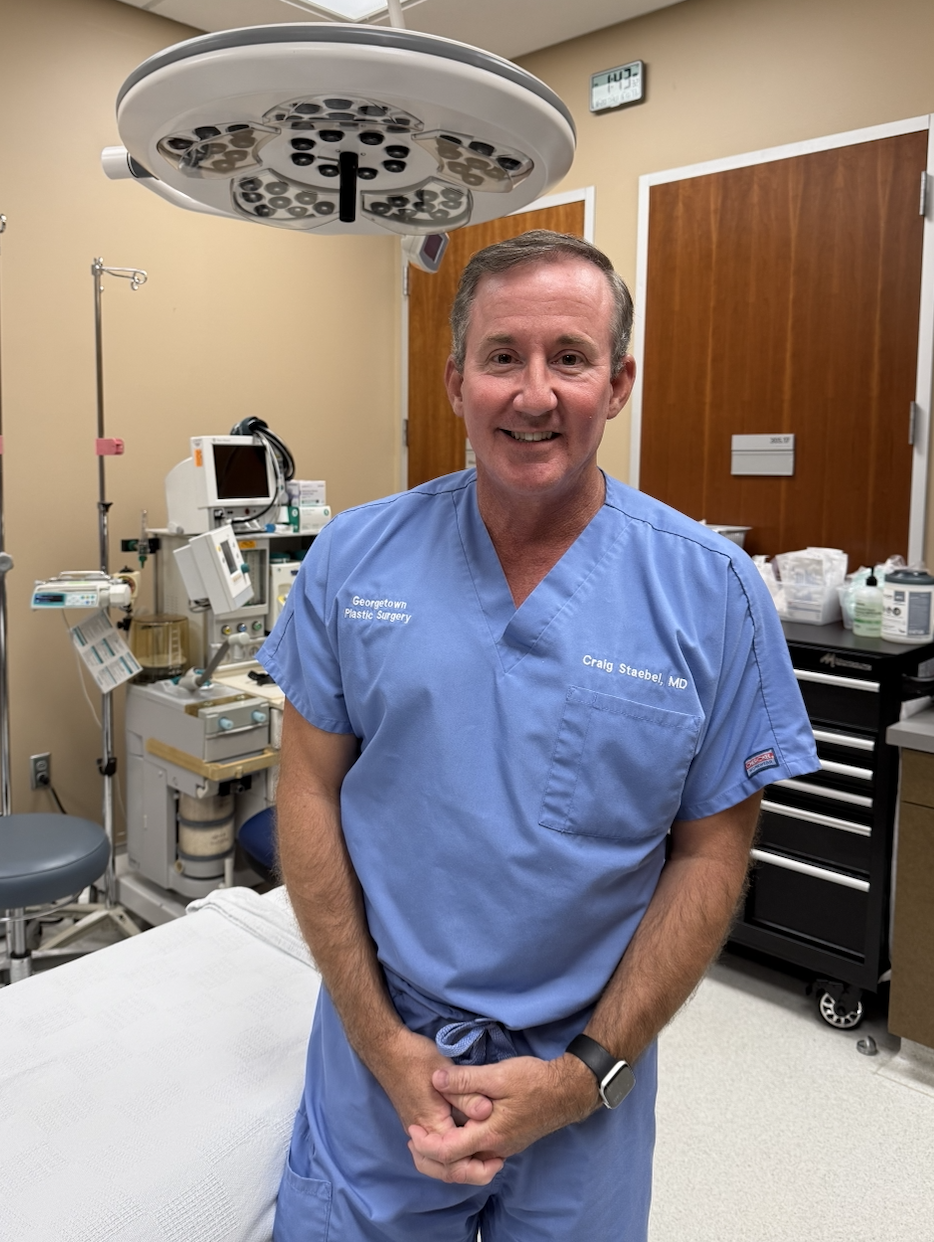
Dr. Craig Staebel has a Post-it note on his office computer that reads, “People may forget what you say but they don’t forget how you made them feel.”
The sentiment is important, he said, because the patients who come into his office aren’t just looking to change how they look — they’re trying to change how they feel.
Dr. Staebel has been operating at his practice, Georgetown Plastic Surgery, for the past 20 years. He is a board-certified plastic surgeon and has his own private operating room attached to his clinic.
He said he performs about 1,000 operations per year, ranging from minor procedures to major operations. In recent years, he has seen an upswing in younger patients. There has also been an increase in skin reduction surgeries due to the rising use of GLP-1s.
The majority of Dr. Staebel’s patients are women in their mid 30s and early 40s. He also has many clients from Sun City, who come in for facelifts and eyelifts.
“One of my patients said to me years back, ‘You know, as a woman, as you get older, you turn invisible because nobody looks at you.’ And it just kind of made me want to cry,” Dr. Staebel said. “That’s one of those things that sticks with me. Hopefully, I’m making people want to be visible again.”
Dr. Staebel said became a plastic surgeon because he wanted to learn how to mold the human body. The word “plastic” comes from the Greek plastikos, meaning to mold or shape.
He realized that he wanted to become a plastic surgeon during his medical residency, while watching a surgeon perform a paramedian forehead flap after removing skin cancer from the tip of a patient’s nose.
The operation involved lifting up tissue from the patient’s forehead, keeping it attached to its original blood supply and rotating it down to close the hole in the nose. After about two weeks, the flap was separated from the forehead since it had established blood supply from its new location.
“I had no idea you could manipulate anatomy in such a way to do good. To me, it was like mastering anatomy — being able to master it to the point where you can manipulate it and make it do what you wanted. Whether it's recreating a breast or tightening a face or filling a hole left by cancer.”
Early in his career, Dr. Staebel spent many nights in the emergency room doing non-elective surgeries — like operating on injured hands or burn wounds. He now only does elective surgeries in his own private practice. He explained that surgeons in larger hospitals are pushed to use certain surgical techniques and medications to save money or time.
“In private practice, I’m not encumbered by anything,” Dr. Staebel said. “I can do absolutely what I think is best for a patient and for me.”
Although most practices have nurses conduct consultations with patients, Dr. Staebel does all his consultations himself. Consultations last around 45 minutes to an hour, depending on the patient.
“I can tell them exactly what the surgery is about based on their anatomy — what type of skin quality they have,” Mr. Staebell said. “I think it’s definitely more efficient. The consultations take more of my time, but part of what I like is talking to people.”
During consultations, he asks patients what their goals are in getting the operation. If he senses that someone isn’t getting the surgery for the right reasons, then he will turn them away. He once had a woman tell him she wanted breast implants to stop her husband from leaving her.
“I can make your boobs bigger, but I don’t fix relationships,” he told her. “Ultimately, regardless of how awesome surgery results are, [you’re] not going to be happy because it's not going to save a marriage.”
Another patient came in to remove a small mole on their face that was barely noticeable.
“Meanwhile, she had really, really long earlobes and a lot of wrinkles on her face,” Dr. Staebel said. “You’d be amazed what can bother somebody.”
A man with a “beautifully healed” scar on his cheek, left by an enemy during combat, came to Dr. Staebel for a scar revision.
“It was a psychological trauma that he wanted to try to address by making that scar look better. He just wanted that scar to not be from an enemy combatant. He wanted to look at it [and think], ‘Oh yeah, that was a surgeon.’ ”
A young woman with self-harm scars had a similar request. She wanted Dr. Staebel to revise the self-harm scars so she could see marks that a surgeon made — instead of something she had done to herself.
Dr. Staebel said the biggest misconception people have is that they are going to wake up from surgery and look perfect afterward. This is something that he has to clear up with them beforehand.
“The most important thing I tell them during that last visit before the surgery is part of the consent form. There’s no warranty or guarantee as far as the result or cure— which means I try to make everybody as perfect as I can. You’re not going to be perfect when we're done, but the results should be closer to perfect than when we started.”