
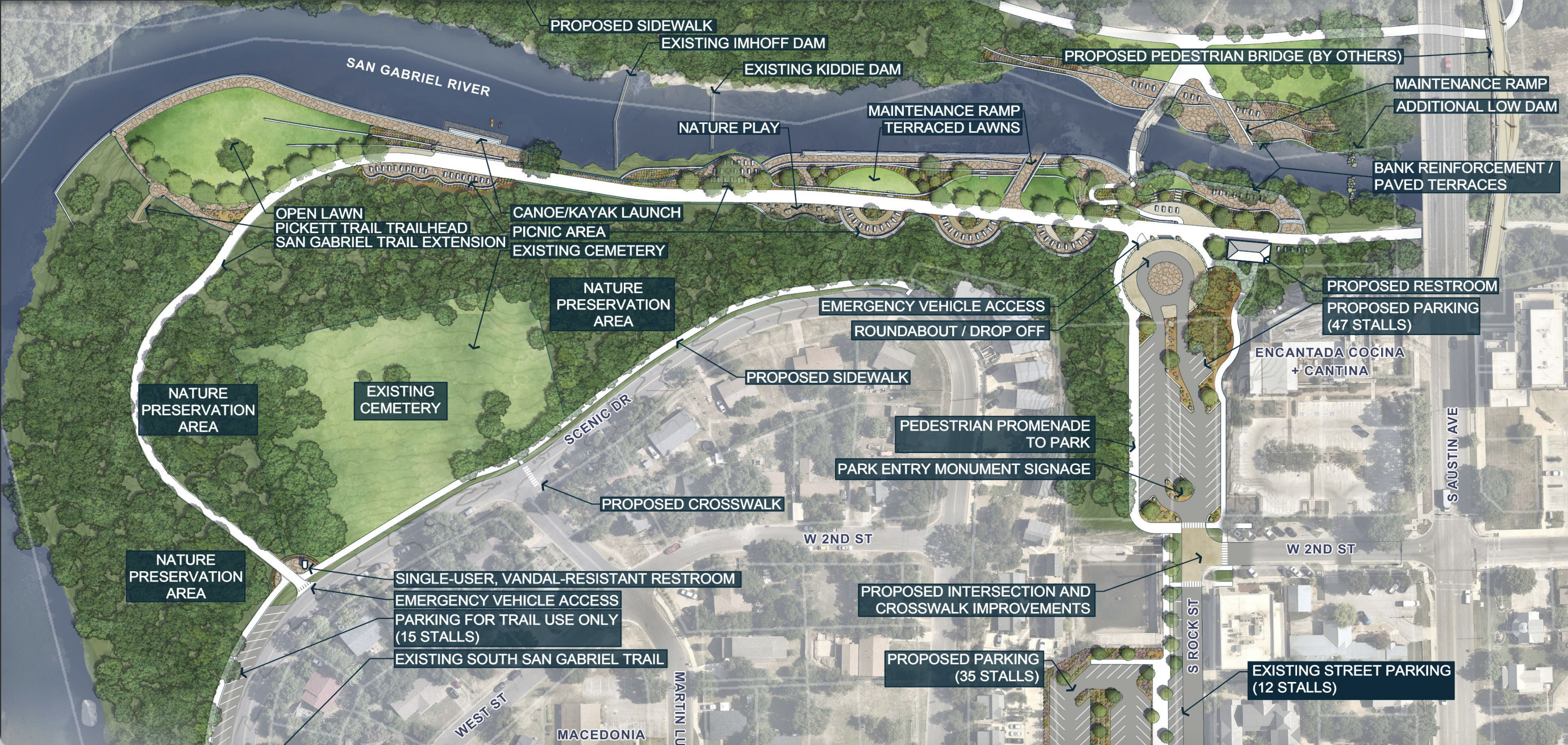
The final draft of the Blue Hole Master Plan shows updated emergency vehicle access, terraced lawns and more restroom facilities are on the way as part of the park’s redesign. The project’s estimated cost stands at $10.15 million.
Based on seven months of resident feedback, park design consultants Halff presented resident priorities to Georgetown City Council on Tuesday, October 28.
“What we really heard from the community respondents was they don’t want to see more stuff in Blue Hole. They want to see the same activities we already have [at the park] improved,” Project Manager Aaron Cooper said.
Residential priorities, according to the Halff study, included:
- Nature preservation and interaction
- Improved restroom experience
- Enhanced parking
- Open space for recreation
- Picnicking opportunities
- Enhanced water access
Proposed new amenities — including a two-way cycle track, an access road through the park and a canoe/kayak drop off — were not deemed important by residents.
Compared to the previous draft for the park, alterations were made based on findings after the San Gabriel River flooded during the July 4 weekend.
“There were some important lessons that we learned from [the flood],” Mr. Cooper said. “One was the importance of riverbank stabilization.”
He also said seeing where the water line reached highlighted the importance of selecting the right materials and furnishings to use at the park, and where to place these elements. The goal, he said, is to protect them from heavy river flow and debris that might be coming downstream.
“We already knew it prior to the flood, but it definitely reinforced the idea that any sort of furnishings in the park, we don’t want to treat as disposable,” Mr. Cooper said.
“It’s not so much we’re worried about future damages. It turned into, there could be a lot of stuff that ends up in the park that we need to account for.”
Included park features
Some elements shown to city council during the workshop included a single-user, vandal resistant restroom off Scenic Drive, a playscape including boulders and logs near the river and emergency vehicle access through a roundabout behind the Encantada restaurant.
“We’ve had [the roundabout] all along, but there were lots of concerns about [emergency vehicle access], so we wanted to call that out specifically,” Mr. Cooper said. “Fire, ambulance, police, they all will have access along the entire river’s edge.”
The owner of Encantada, Alex Webber, attended the meeting and asked that a proposed bathroom by the roundabout near the Encantada patio be moved to the other side of the roundabout.
“I would propose just flipping it,” he said. “You would still benefit from easy access to the police department, it would be centralized. We have one of the best patios in all of Georgetown, having a public restroom and a manhole between what is beautiful riverside views is aesthetically not what I want to manage.”
Looking at bids on similar projects, Mr. Cooper said the $10,153,381 cost would comprise of $7,534,481 for construction, $1,087,900 for an estimated design fee and $1,531,000 for a 10 percent contingency.
At this point in the planning process, Mr. Cooper said there are still “plenty” of unknowns, which is why the contingency was included. He said contingency costs would decrease as further design is done.
Parks and Recreation Director Kimberly Garrett told city council there is currently $7 million in funding for the project that will be available across Fiscal Years 2026 and 2027.
“We had estimated $6 million [for construction]. That was our best guess without doing any work at all,” she said.
Council feedback
Council Member Jake French said he liked the plan, but felt improvements to parking and roads should be secondary to improvements to the actual park space.
“If we have limited funding that we’ve incorporated into our debt forecast, my recommendation would be we make the improvements on the park first,” Mr. French said. “ I understand the feedback from the community is that they need a place to park, but I think that’s beyond the spirit of what we’re trying to do, which is enhance the natural beauty of Blue Hole Park.”
He said if city council decided to phase the phased improvements, he would handle parking and road improvements at a different time.
“We can work through [what would be in each phase] during the design process,” said Nick Woolery, assistant city manager. “We can also see if there’s anything else that’s potentially phaseable that we could do as bid alternates during construction.”
Council Member Amanda Parr said her concern with waiting to do parking later was potential impacts to park usability and the aesthetics of the park that would have just been improved.
“I understand phasing things from a cost perspective, I just want to be sure we do that where the park is in good condition and accessible to those who are excited about using this improved facility as soon as possible,” she said.
Council Member Kevin Pitts asked city staff if there was a way the city’s capital improvement projects could be adjusted so there wouldn’t have to be phases and the project could be done all at once.
“I’m afraid if we do [the park improvements] and it’s very popular, it’s going to make the parking problem even worse than what it is now on popular days,” Mr. Pitts said. “I’d rather try and do this all at one time instead.”
Speaking of the proposed parking elements specifically, Mayor Josh Schroeder suggested designing the parking lots in a way that they could be altered in the future. This would allow spots at the park to be removed once the city’s future parking garages and surface lots nearby are built.
More developments will continue to be made on the plan as design documents are worked on throughout 2026.