
Church, council member see “Be Your Own Person” mural as political message supporting LGBTQ+ community
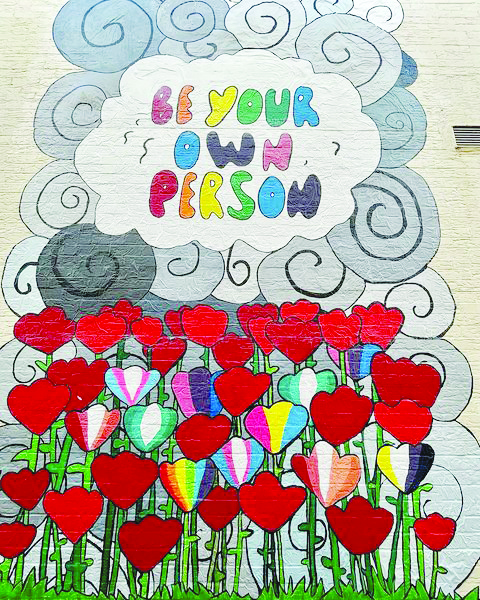
A new mural tucked away in the alleyway between two buildings on Seventh Street in downtown Georgetown has stirred up controversy.
Since its mid-April installation, some residents and a city council member have criticized the art piece referred to as the “Be Your Own Person” mural for design elements that could represent the LGBTQ+ community. Others in the community have supported the work and its message encouraging individuality.
“To me, [the mural] is a political statement and we should not be putting up art like this in our city,” District 5 Council Member
Kevin Pitts said during a city council workshop after the piece was installed. “This is divisive.”
Located on the back wall of Tejas Meat Supply, 101 East Seventh Street, the mural is part of the GISD Student Mural Project, which is a collaboration between the Georgetown Independent School District and the city’s Arts and Culture Advisory Board.
The collaborative program allows students to design and install up to five murals on the side of the building, with one mural added to the wall per year thanks to a five-year mural easement between the city and the property owner.
Designed by an eighth grade student from Forbes Middle School, the mural displays the message “Be Your Own Person” in
multi-colored lettering. A collection of red and colorfully striped poppies — some of which mimic the patterns of LGBTQ+ Pride flags representing the bi-sexual, pansexual and lesbian communities — is included at the bottom of the piece. The mural is the program’s second installation.
Because it is located in a narrow, unpaved alleyway between two buildings, the mural is not visible from Seventh Street and not frequently passed by on foot.
“The overall theme of this project is ... to recognize everyone’s individuality and accept that we are all different in our own unique way and reinforce our differences as a positive thing rather than something viewed as negative,” reads the student artist statement posted to the city website. “It allows residents and visitors to Georgetown [to] feel free to be themselves. It isn’t bad to be different and spreading the message may help people who have been taught otherwise and let them feel comfortable in their environment.”
Council concerns
Georgetown City Council members discussed the content of the mural at an April 24 council workshop, during which Arts and Culture Coordinator Amanda Still gave a presentation on public art projects located throughout the city
Mr. Pitts asked questions about who approved the mural design and what criteria the artwork had to meet in order to be installed, noting one of the multicolored poppies displays the colors and patterns of the Transgender Pride flag.
“As for representing everyone, I am a middle-aged, overweight, balding white man who has high blood pressure and psoriasis, so I’m just curious which one of these flags represents that individual identity and that individual person?” Mr. Pitts asked during the workshop.
Mural designs must meet the standard mural guidelines adopted by the city and the advisory board before receiving approval, Georgetown Communications Manager Keith Hutchinson said in a statement.
Student artists must also submit a design and concept packet to the GISD Fine Arts Department to be considered for the GISD
Student Mural Project, Ms. Still said. After the district conducts its own selection process, final designs are presented to the city’s Arts and Culture Advisory Board for approval.
“The intent of the artist here is to invite everybody to be their own person,” Ms. Still said. “It’s the right of the viewer to interpret art the way they would like and oftentimes, the interpretation of the viewer is never even what the artist intended for it to be. That is the beauty of art.”
Mr. Pitts expressed concerns that the mural’s message was divisive, and said it was political.
During an interview with the Sun, Mr. Pitts defined political artwork as anything with “political motivations and is a divisive issue that is being talked about actively at the time, particularly that is being argued on both sides of the political aisle.”
Public art, he said, especially when installed through a city sponsored program, should avoid delving into such themes.
“I believe there is a risk to the city and the citizens if we meddle in national political issues that we don’t control,” he said. “Certain things, all things are political whenever you’re elected, right? But our politics is whether to allow development to come, where to build a road or extend a wastewater line or how to allocate money for the budget.
“Those are the things we need to worry about, not national issues we have no control over.”
Mr. Pitts asked city staff to look into changing public art guidelines to avoid issues of divisiveness. His concerns were echoed by then council members Tommy Gonzalez and Steve Fought, both of whom are no longer serving on council after their terms expired in May.
A review of the guidelines is “currently in progress” and being conducted by city staff, Mr. Hutchinson said earlier this month.
Public reacts to mural
The mural has become a topic of community discourse, with residents speaking both for and against what they interpret as the mural’s messaging during the public comments portion of various City Council meetings.
During a May 10 City Council meeting, Laura Sewell called out Mr. Pitts for his comments about the mural. She said his comments were both intolerant and politically motivated. She also presented letters written by 60 residents that expressed both support for the city’s LGBTQ+ population and disappointment over statements made by council members about the mural.
“Not only is the mural not political art, it is by my interpretation a gorgeous piece of artwork that conveys the notion that all people belong and that Georgetown supports inclusivity and diversity,” Ms. Sewell said. “All [was] lost in the moment because of Council Person Pitts.”
Ms. Sewell formerly served as vice-chair of the Arts and Culture Advisory Board, and lives in Mr. Pitts’ council district.
At least four speakers during public meetings this spring who have objected to the mural identified themselves as congregation members of a nondenominational Christian church called The Church on the Square. The church’s pastor, Bradley Helgerson, was the first to speak out against the message during the April 24 workshop.
During his comments, Mr. Helgerson called out the LGBTQ+ community for being an “abolitionist movement which is driven by resentment,” and criticized the city’s Arts and Culture Advisory Board for allowing its message to make its way to the downtown area.
“I know this seems extreme in the context of one mural, but it’s not just a mural,” Mr. Helgerson said. “It’s a piece of propaganda for an ideology that seeks to destroy Western civilization and to use our children as its foot soldiers.
“It’s not real culture we’re talking about, it’s anticulture. To refuse to push back against it now will mean the substantial loss of real liberty for our children in the future.”
Church makes allegations
On May 6, the church published a Facebook post claiming it had been “canceled” following the public comments pertaining to the mural that were made by Mr. Helgerson and other congregation members.
“We received notice today that our rental lease with the Palace Theatre has been terminated, effective immediately,” the post reads. “No doubt this is in retaliation for my remarks at the city council meeting last week.”
The Church on the Square has rented space for its weekly services from the Palace Theatre for the past year, explained Art Rodriguez. Mr. Rodriguez is president of the theater’s board of directors.
The space was being rented on a month-to-month basis and was available because of a lack of theater programming caused by the pandemic. However, with operations back to full capacity and summer programming about to start, the theater has less availability for outside renters. The Palace informed the church of the change in early May, he said.
“This was purely a resource management decision for us,” Mr. Rodriguez said. “And quite honestly, when we started hearing things that were tying it to some comments that they made, it was a little shocking because we don’t monitor the city council meetings.”
Coverage of Mr. Helgerson’s remarks claiming the church was wrongfully banned from the theater space because of comment was picked up by some online media organizations including The Federalist, a Conservative-leaning online magazine focusing on politics and religion.
The Sun reached out to Mr. Helgerson and the Church on the Square for additional comments, but did not receive any before this story’s deadline.
Mr. Rodriguez said he was surprised to hear the church’s allegations against the theater and called the timing of the city council meetings and the rental termination “unfortunate.”
“From our perspective, we just needed the space [for the theater’s programing],” Mr. Rodriguez said. “Whether in the future
there may be space or room for [the church], we’ll address that then, but right now, we’re looking at our foreseeable future and we don’t have the luxury of providing that space anymore.”
The Church on the Square announced it will now gather at a new location, The Williamson County Courthouse lawn near the corner of Main and West Seventh Street, although last week, work on the courthouse lawn forced the group to relocate. Weekly service begins at 10 a.m.