
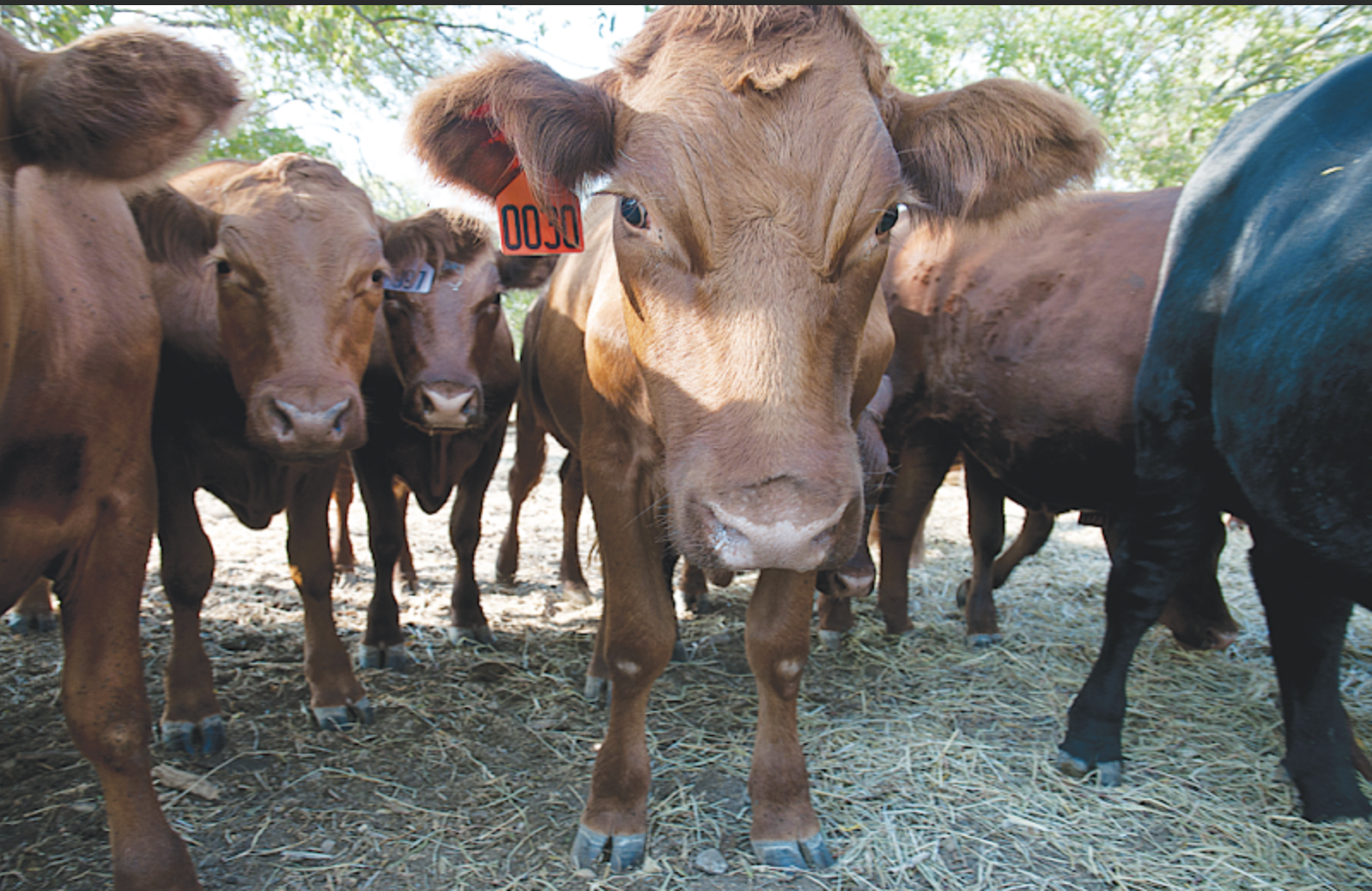
Despite the rapid growth of technological businesses in Williamson County, agriculture remains a top industry, providing jobs and food for both those in and outside of the county.
According to the Farm Service Agency there are 291,000 acres of cropland in Williamson County. From that land, as of July 2023, there is 103,703 acres of corn, 6,443 acres of cotton, 3,519 acres of sorghum and 10,181 acres of winter wheat.
In 2017, the agricultural products in Williamson County with the highest market value of products sold were grains, oilseeds, dry beans, dry peas with $42 million in sales and cattle and calves with $44 million in sales.
Although some rain fell in September, drought.gov still labels 97 percent of Williamson County as being in D4, the most extreme level of drought.
Corn farmer Larry Svehlak planted an early crop of corn in February, which saw great success. His February corn sprouted out of the ground within a week because of how warm it was.
However, a second crop of corn planted in April saw yields cut in half because the corn did not get any rain and faced triple digit heat all summer.
“As far as the early corn, I was well pleased with my yields,” he said. “It got hot, [the late corn] went through a lot of stress.”
Weather and crop yields
The extreme drought that affected Williamson County and much of Texas this summer was partially unexpected for the over 2,500 farms counted in the most recent U.S. Department of Agriculture’s Census.
Gary Pastushok — A&M AgriLife Extension Office County Extension Agent who specializes in agriculture and natural resources — said a La Niña event from last year, which typically brings drought to the southern U.S. and heavy rains to Canada and the Pacific Northwest, lasted longer than expected, and things began to dry off in April.
“[The drought] was not completely unknown because we knew there was going to be a La Niña event, “ he said. “It was really rare though, that one event lasted a year longer than it usually does. That if anything was a trigger."
The A&M AgriLife Extension Office – which provides publications, training, programs and apps to give Texans the latest agricultural, natural resource and life science research – started seeing the impact of the drought after an El Niño weather event did not start when predicted.
“We didn't notice it during the winter, because the rainfall events were just perfect timing and enough quantity that the crops took off pretty well,” Mr. Pastushok said. “The winter wheat looked really good, the corn progressed really well and it looked like the whole year was going to turn out well.
“Then they predicted that El Niño was going to be coming, and we were thinking June, July, August that period. We figured this might be a good summer rainfall event for the farmers. They were a little wrong, the El Niño didn't develop. It’s developing now.”
Based on the original prediction from when El Niño would hit and its current development, the weather phenomenon is four months behind. This means the summer rains that were expected from El Niño never came. Instead, farmers and ranchers faced severe heat, water restrictions and drought.
Mr. Pastushok said the annual rainfall recorded from the Georgetown airport is 22.7 inches. As of October 2, the county was at 10.6 inches, with the most recent large bout of rainfall happening on April 20, with 1.6 inches.
“Essentially it’s coming into a year, where we're already probably 10 to 12 inches down anyway. So when you look at this, we're down almost two feet of normal precipitation. So, we're going to have to have some historical rainfall events to be able to catch up anywhere [close] to [where] normal would be,” he said.
According to the Sustainable Agriculture Research & Education organization, “climate has a large influence on crop growth, yield and quality through seasonal patterns of temperature and precipitation. Plants are most sensitive to extremes of temperature and moisture during the reproductive phase in which flowering, pollination, fertilization and fruiting occur.”
Mr. Pastushok said that some of the crops did fail during the summer. He said it was “one of the worst years ever” for cotton. Cotton farmers usually expect somewhere around two and a half bales – each bale weighing about 480 pounds he said. This year, a lot of cotton farmers only produced half to two thirds of a bale.
Mr. Svehlak said he usually grows cotton in addition to corn, but is glad he decided against growing cotton this season.
“What it was, the bulbs were so little there wasn’t anything in them,” he said. “Cotton’s a hot, dry plant. It was just too hot and too dry. It took a whipping.”
When it comes to crops, something farmers do to try and reduce the amount of impact that extreme weather events have on their yield is to store as much product as they can when they have a good yield, according to Mr. Pastushok.
Livestock industry impact
According to the Sustainable Agriculture Research & Education organization, “livestock can acclimate to gradually changing temperatures, but long periods of temperature extremes or extreme or rapid fluctuations in temperature will reduce productivity and can sometimes result in death.”
Jim Schwertner, who owns the cattle brokering business Schwertner Farms, said that in his experience, droughts like the one this year come around every decade.
“There’s a 10 year cycle in Texas [when this happens]... but usually when you come out of a severe drought like this, it starts flooding,” he said. “So, it'll be extremes.”
Even though Schwertner Farms has not felt the impact of the drought as much as others in the community, there has still been an impact on the business.
“This year has probably been harder than last year because of the drought,” Mr. Schwertner said.
The drought has caused farmers to sell their cattle. However, he said the cattle market has been pretty good.
“The last six months, I’m surprised how good the market has been, because of inflation,” he said. “The ranches were not hurt as bad as it could have been because of inflation.”
Despite the drought the county and much of Texas has been facing, Mr. Schwertner has confidence in the beef industry’s success.
“I tell my employees and my kids, it’s always gonna be good as long as you go to McDonald’s or a steakhouse, and people are eating [beef],” he said. “People need beef, people love beef.”
If the drought continues
Even though some farmers and ranchers are facing less production than usual or have to reduce their herd, Mr. Pastushok said there are government programs available to help.
When the Farm Service Agency office heard about the low cotton produce, emergency payments were triggered to cotton producers to help keep their farms afloat.
Mr. Svehlak said there are new corn hybrids coming out that are more drought resistant, but in his experience he did not see that much difference between that hybrid and his usual type of corn.
“They’re coming out with the new hybrid corn and they say it’s helping and it’s more tolerant to dry [weather],” he said. “Then, if you plant it, and then you might be cutting into your yield by not making as much as you know, say if it's a wet year, and then you planted that corn, that other hybrid would probably make more than the hybrid that’s drought tolerant.”
Farming is a business that naturally goes up and down, Mr. Pastushok said. With land prices rising from the growing demand for land in Williamson County, he said large farmers are selling their land and buying land in less expensive neighboring counties.
“When you look at the amount of business industry moving and look at the price of the value of land, it’s too expensive to get into farming,” Mr. Pastushok said. “But it sure is easy for a lot of them to get out of farming quickly and really make a lot of money flipping the land for whatever.