
Water service will not be interrupted by planned changes effort
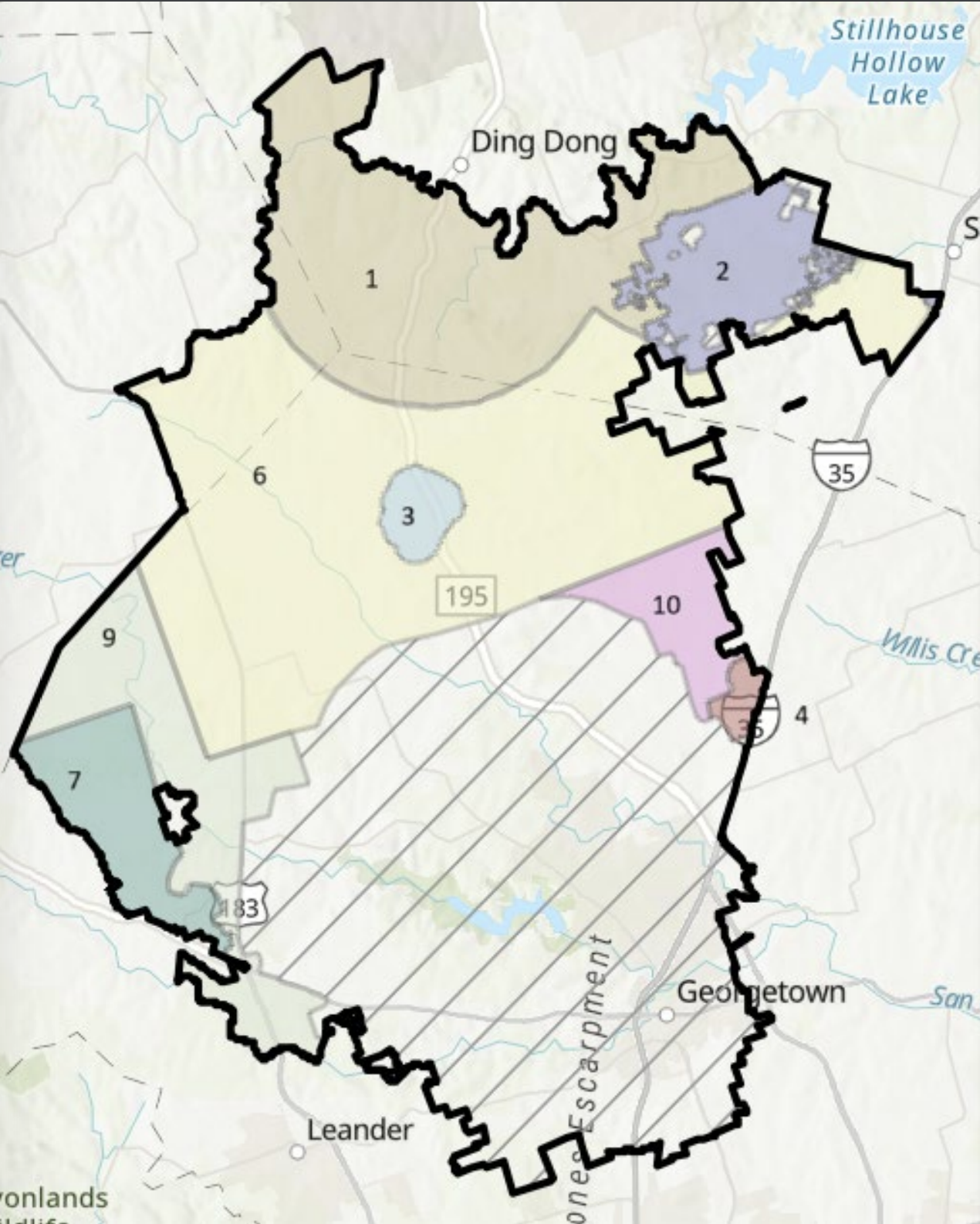
The City of Georgetown will sell off pieces of its 400 square-mile water service territory that currently serves more than 74,000 customers.
The city’s plan is to keep service for all customers within the city limits, extraterritorial jurisdiction and a portion of the territory west of the ETJ to Highway 183. Other areas, however, could be sold off to a different water utility provider.
One of the main reasons the city is undertaking this project, according to Strategic Projects Manager Caroline Stewart, is to decrease the city’s potential future water deficit. By selling parts of the CCN territory, the city would decrease the amount of acre-feet per year it would need to serve City of Georgetown-based customers from 100,000 to 41,000.
“When [Georgetown] acquired Chisholm Trail [Special Utility District a few years ago], there was very little growth expected and then look what happened, just unprecedented growth in the Covid era,” Ms. Stewart said to city council during its August 26 workshop.
Currently, the city is investing $414.9 million in capital improvement projects that serve areas outside of city limits and the ETJ. According to Ms. Stewart, that represents 86.2 percent of Georgetown’s active water and wastewater capital improvements.
If capital infrastructure costs continue in the direction they have, Ms. Stewart said water rates would dramatically increase for customers outside the ETJ.
“We’re hoping that by finding a new utility that’s able to provide these customers service closer to where they are, that’s going to stabilize rates for everybody.”
History of the water service territory
Those who get water from Georgetown utilities are a part of the city’s water Certificate of Convenience and Necessity, more commonly known as the water service territory. Ms. Stewart said it’s becoming more common for city utilities to serve residents and those who live in the city’s extraterritorial jurisdiction.
The ETJ is a designated buffer area just outside the city limits, according to the city. Properties within the ETJ may receive certain services from the city like water and electricity, and must follow certain city ordinances, but do not pay city taxes or vote in city elections. ETJ is designated to cities by the Texas Local Government Code to help define potential growth and future service boundaries.
“Cities don’t typically establish water utilities to serve large regions,” Ms. Stewart said. “Largely because that accompanies a lot of risk, particularly in this environment with the legislature where we have very little control over development outside of our ETJ.”
Georgetown’s CCN got to be so large because of the dissolution of the Chisholm Trail Special Utility District. Ms. Stewart said the SUD was having trouble managing the service territory, so they asked if the city would take over a small portion. However, the state legislature said the city could not take over just a small portion, it would have to take over the entire Chisholm Trail SUD.
“At the time, [the SUD] was largely rural, but currently those customers that are within the old Chisholm Trail district are using more than 800 times the water that they initially brought in that acquisition,” Ms. Stewart said.
Talking to other cities
In the proposed plan to sell a section of the district, about 11,500 water customers would be transferred to new water utilities. About 62,000 would remain within Georgetown’s CCN.
In a timeline shown to city council Tuesday, Ms. Stewart emphasized this is not a “one and done process,” but something that will see results between 2027 and 2029.
“The first step is we are talking to our neighboring cities about whether they are interested in buying the area that falls within their ETJ,” she said. “We want to be good neighbors, we want to make sure that these current customers are taken care of.”
Many of the portions of land the city is looking to transfer are within the ETJ of other cities including Salado, Killeen, Jarrell, Liberty Hill and Florence. There are also three portions of land that don’t fall within the ETJ of any city.
“There are some cities like the City of Salado or Jarrell, where there’s no infrastructure at all, there’s no customers. So for them to take it over, there would not be a lot of technical requirements,” City Manager David Morgan told the Sun. “There’s areas like Liberty Hill, where there’s a pretty good amount of consistent customers, over 2,000 and with the infrastructure that’s in place it’s a multi-million dollar acquisition for them to do that.”
He said considering the two different scenarios, one is more of a straightforward decision for a city and the other will take more analysis.
From a city management perspective, Mr. Morgan said its important to have a water utility that is predictable, local and reliable for those in the community. He said it’s a unique situation to have someone who considers themselves a Liberty Hill resident to go to Georgetown for water utility services.
“[If] I live in Liberty Hill, I go talk to the Liberty Hill [city] council to deal with water issues, instead of I live in Liberty Hill, but I have Georgetown water, and I have this and that, so where do I go for what,” Mr. Morgan said. “That’s the intent around why we’re wanting to give the opportunity for these other cities to take over portions of their ETJ. ETJ areas are not in the city limits yet, but could be, they’re part of the planning. So it may be areas that get annexed as a part of that city, someday in the future.”
Taking care of customers
“We’ve had to do a lot of rate increases over the last few years to accommodate, largely, the capital infrastructure and our new water contracting,” Ms. Stewart said. “We’re really hoping that [selling the land] is going to stabilize our rates and allow for some more steady increases going out into the future.”
Ms. Stewart said the priority in transferring this land is not to sell it to the highest bidder, but make sure the customers are taken care of. Georgetown staff will look at long-term water service ability, infrastructure plan and rate stabilization plans.
“We’re not cutting anybody off with water, this is not something where we’re going to stop providing water,” she said. “We’re going to make sure that any current customers have continued water supply. Part of the [Request for Proposal] is we’re going to offer to provide water for a short-term period while any new provider is getting up to speed, getting the facilities built out, anything that’s needed.”
Getting water through contracts
Even with the proposed CCN sale, the city is still pursuing water contracts with EPCOR and Recharge Water, LP for 39,399 acre-feet per year and 34,800 acre-feet per year respectively.
Ms. Stewart said even though the city is actively negotiating long-term contracts with both companies, it will proceed with the deal that will best serve the city’s long-term interests.
The city previously canceled a contract with GateHouse Water, LLC that would have provided 18,500 acre-feet of water per year due to technical and financial issues discovered during a due diligence period. In the presentation shown to council, a previous potential buyout of GateHouse’s assets were deemed not economically viable.
“We’re actively contracting for new water supply, and without a firm grasp on what our long-term population water needs are going to be, it’s really difficult for us to nail down those contracts,” Ms. Stewart said.
Considering the contracts and the land in the CCN that is sold shifts the way the city thinks about water acquisition and developing new long-term water sources, according to Mr. Morgan.
“The goal, from a planning standpoint, is to make sure that we don’t run out of contract water, but we also don’t acquire so much [water] that we have a lot of extra [water]. It’s good to have a healthy buffer, but not an excessive amount. So our plan is, from a water acquisition standpoint, not to bottle all the water all at once, but to phase it over time.”