
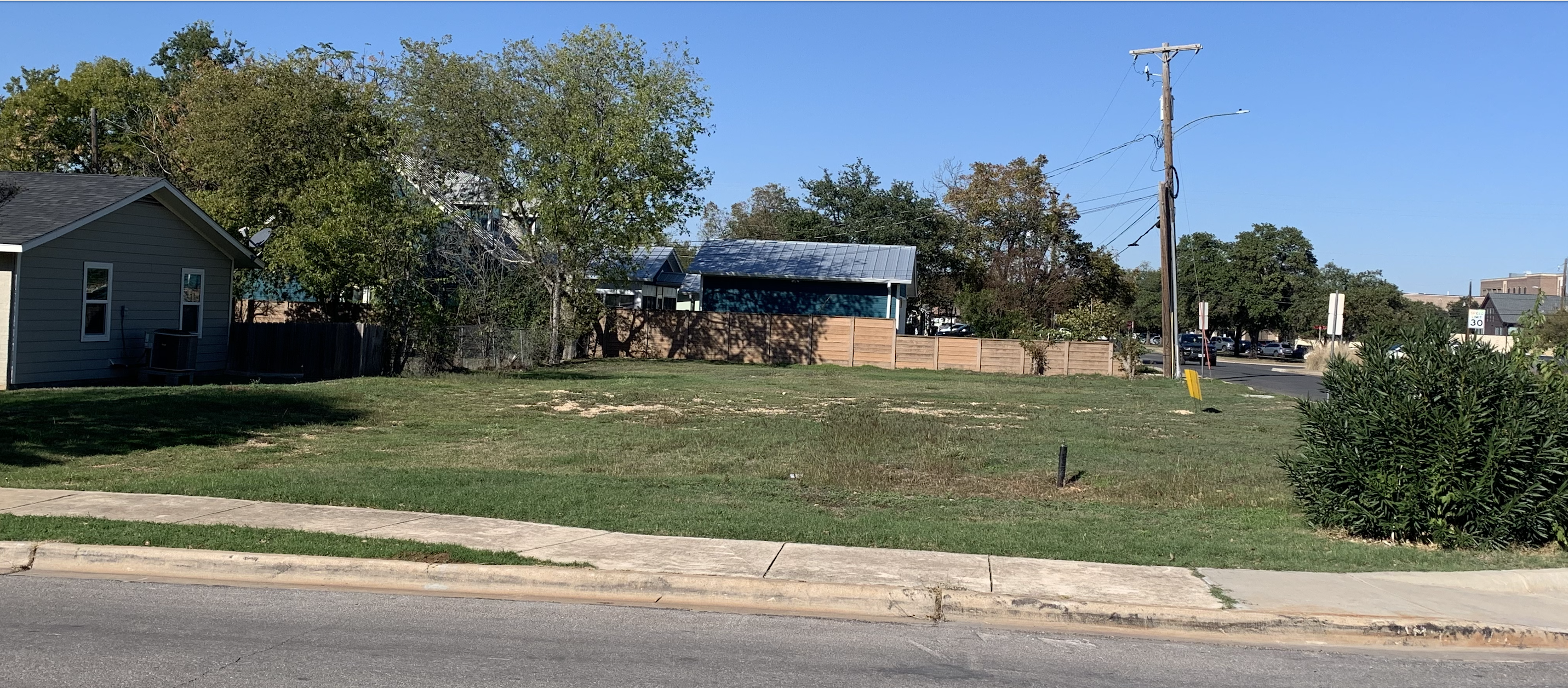
Despite trepidations from residents of the Track-Ridge-Grasshopper neighborhood, Georgetown City Council unanimously approved a zoning change on November 25 for a vacant property at 501 West Eighth Street.
The property had been zoned C3, which is the highest-density commercial zoning the city has. The application is to downzone the property to C1 zoning, the lowest commercial zoning with more limited uses.
Track-Ridge-Grasshopper residents voiced concerns about the rezoning because they felt the original zoning would protect the neighborhood better from commercial development.
Judy Hume, who lives next door to the subject property, said she didn’t feel like the neighborhood would be in jeopardy if the property stayed a C3 zoning because it wasn’t “feasible” for developers to build something as large as allowed on the property.
“If we change it to C1, I’m really concerned about what it’s going to do to the neighborhood with retail and two-stories, and people leering into my backyard, the parking, the further gentrification of the neighborhood,” she said. “This is a residential neighborhood, and I would like to see residents there as my neighbors.”
During the November 25 Georgetown City Council meeting, Edgar Garcia, Georgetown’s Planning Director said the opposite. He said that a downzoning to C1 could protect the neighborhood more.
“It would be a tight and difficult parcel to develop, but certainly something could be fit in there,” Mr. Garcia said.
He said, in his previous experience working for a private developer, a development team would be able to fit a C3 project onto the space if they wanted to. The chance to C1 limits what commercial projects can be built.
The property in question is also in the courthouse overlay district, which implements certain building height restrictions.
“It is further designated as Medium Density Mixed Housing, which is intended to provide ‘missing middle’ housing, so some townhomes, some two-family that are more compatible with single-family dwellings,” Mr. Garcia told council. “Secondary uses are permitted, however, which include retail, office and institutional and civic uses.”
Gary Wong, who represented the developers, said the proposed building would be for retail and offices.
“We can and have drawn something that is very, very tall. We started this endeavor with [previous Planning Director] Sofia [Nelson] when she was still here,” Mr. Wong said. “In meeting with Sofia, that’s what began this discussion, because we were not proposing [but] we did show and draw with the owners what was a 50-foot tall building. And they did not want to do that, they did not want to do a building of that height. We scaled it down, we made a building that is more appropriate for the neighborhood, we believe.”
According to Mr. Garcia, even though C1 zoning is intended to serve residential areas, it “tends” not to be appropriate along residential streets or residential collectors. However, he said because the neighborhood is so close to downtown, it’s not “a full residential street” like a cul-de-sac.
The president of the TRG neighborhood association, Carlos Bustillos, said if this rezoning was passed, it would be the “first domino” to transform the area.
“It’s going to be all commercial that is going to go up after this,” he said. “It’s easy for someone to come in, only been there for a month, and say ‘we can do this, we can build’ and not take into consideration how that’s going to affect the community that lives there.”
Both members of the TRG neighborhood and city council members expressed they would rather the property be zoned as a residential building. However, Council Member Kevin Pitts said council has to take the application as it is.
“If this property were residential today and being requested to be changed to C1, I would be opposed to the zoning,” Mr. Pitts said. “I would prefer it to be residential, however the applicant is not bringing up an application for residential, they’re bringing up an application for C1.
“Moving from C3 to C1 reduces the allowable uses, which is better for the neighborhood compared to the uses that are allowed in C3 now. It also reduces the size of the building. It’s a downzoning, a downzoning in a residential area, the property shouldn’t be C3 in my opinion.”
Council Member Amanda Parr — whose district covers part of the TRG neighborhood — said she thinks C1 allows for some uses in the neighborhood that could work and are “much less intense” than what would be built with a C3 zoning.
“This is a hard one, but I definitely feel like it is the best for the neighborhood today and the best for the neighborhood moving forward,” she said.
In her comments to the audience, she also encouraged Mr. Wong, the developer’s representative, to have a conversation with TRG neighbors and the neighborhood association.
“This neighborhood does have really great intentions. They’ve made a lot of great progress with their neighborhood plan, and they want to see their neighborhood continue to thrive and work for them and the future of the neighborhood,” Ms. Parr said.
Even though the council unanimously voted to approve the decision, Mayor Josh Schroeder said the decision to approve the downzoning is a difficult one.
“Nobody up here is happy with the decision we’re faced with today, it’s not ideal for anybody,” he said.
Commercial 3 zoning uses vs Commercial 1
The main argument of Georgetown City Council to approve the zoning change was the more limited commercial uses that are allowed in C1 versus C3, which is the highest commercial zoning in the city’s building code. Below are the business types for each zoning that could be automatically approved with additional permits.
C3 zoning uses
- Assisted living
- Nursing or convalescent home
- Hospice facility
- Emergency services station
- Government or postal office
- Library or museum
- Social service facility
- Hospital
- Blood or plasma center
- Nature preserve or community garden
- Inn
- Hotel – boutique, full service, limited service or extended stay
- Motel
- Restaurant, general or drive-through
- Food catering services
- Theater, movie or live membership club or lodge
- Consumer repair
- Small engine repair
- Funeral home
- Veterinary clinic, indoor pens only
- Event catering and equipment rental
- Parking lot, off-site and commercial
- Private transport service dispatch facility
- Transit passenger terminal
- Utility services, minor, intermediate and major
- Home health care services
- Medical or dental office or clinic
- Urgent care facility
- General office
- Integrated office center
- General retail
- Agricultural sales
- Landscape supply sales/garden center
- Farmer’s market
- Artisan studio and gallery
- Personal services
- Personal services, restricted
- Dry cleaning service, drop-off only
- Laundromat
- Printing, mailing and reproduction services
- Fitness center
- Banking and financial services
- Automobile parts and accessory sales, indoor
- Automobile repair and service, limited
C1 zoning uses
- Group home – seven or more residents
- Assisted living
- Nursing or convalescent home
- Hospice facility
- Rooming or boarding house
- Emergency services station
- Government or postal office
- Library or Museum
- Social service facility
- Hospital
- Blood or plasma center
- Nature preserve or community garden
- Inn
- Hotel – boutique, full service or limited service
- Parking lot, off-site
- Parking lot, commercial
- Park-n-ride, facility
- Utility services, minor
- Utility services, intermediate
- Utility services, major