
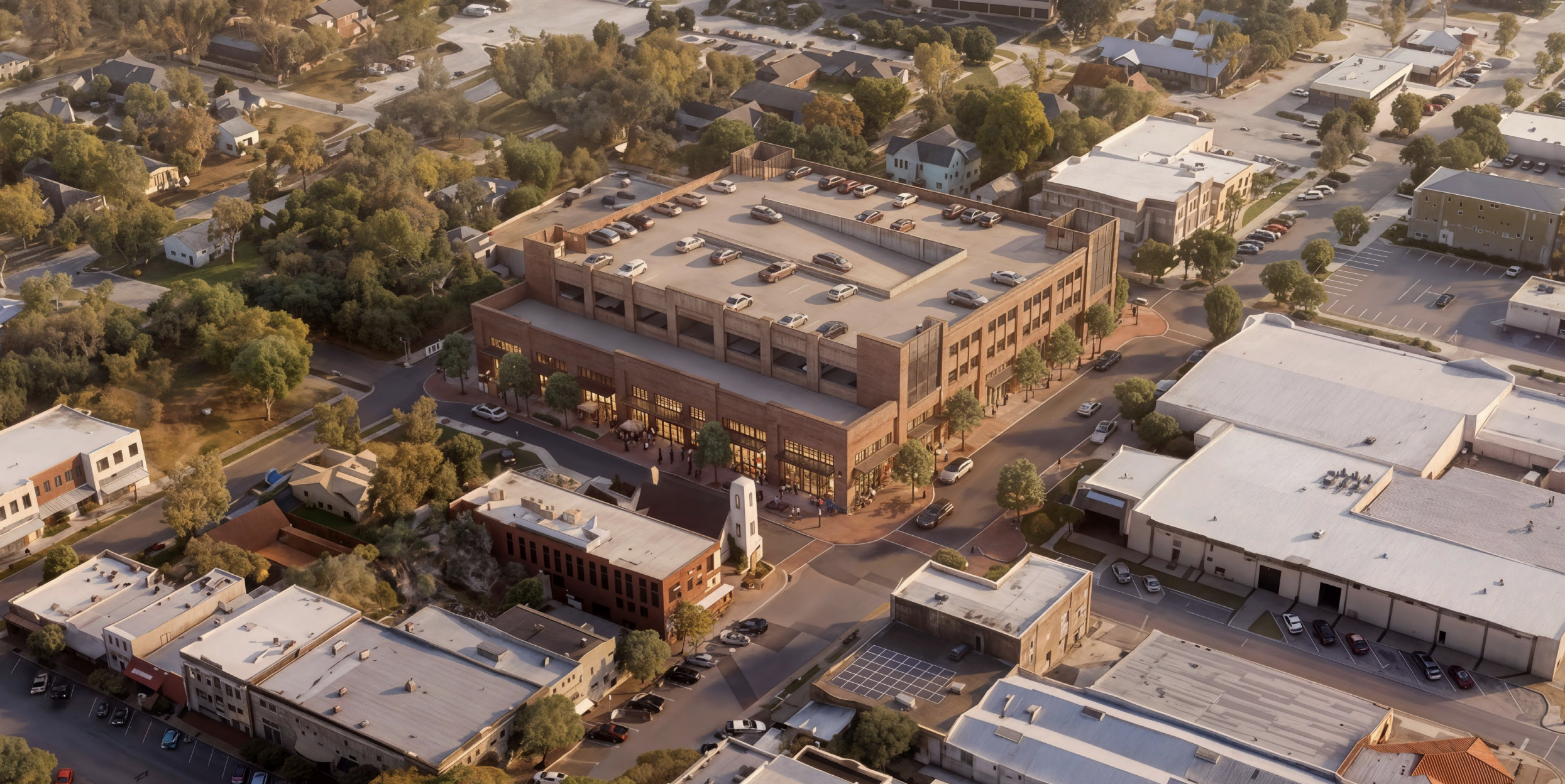
Mere months after the public parking garage at Sixth and Main opened, the City of Georgetown is already working on its second downtown parking garage – this time as a partnership with the Texas Municipal League.
The proposed garage, located at Ninth and Main in the Red Poppy Lot, would bring a net of 314 parking spaces to downtown Georgetown. The goal is to open the garage before reconfiguring parking around the Square, and prior approved changes to Austin Avenue, both outlined in the city’s Downtown Master Plan.
The idea for the garage was already in place, but a partnership with the Texas Municipal League emerged when the organization decided to move its Intergovernmental Risk Pool into the old Wesleyan building at Church Street and University Avenue.
Estimated costs are approximately $29.1 million, and the city would pay about $9.2 million, with Texas Municipal League paying the rest.
“Parking for our employees is a priority, but another key component of the [Texas Municipal Center] is the conference and training facility,” Jeffrey Snyder, assistant executive director at TML Risk Pool, said during the May 26 city council workshop. “Because of that, reliable and walkable parking is important for the long-term success of our building.”
Through the partnership, TML Risk Pool would pay for five-sevenths of 200 parking spaces, and would design, permit and construct the garage. This deal is based on the company not utilizing any spaces during the weekends. Additionally, there will be parking in the lots across the street from their building for employees and guests.
“The proposal to have TML Risk Pool take the lead on designing, permitting and constructing does not mean that they would bypass any process, bypass any procurement law,” Assistant City Manager Nick Woolery said. “They would still go through all the same processes they would need to, it’s really more about efficiency of construction.”
Through the Georgetown Transportation Enhancement Corporation, the city would pay for any cost deltas and maintain the garage long-term.
Also as part of the agreement, Georgetown can not restrict parking or charge for parking in the garage between the hours of 8 a.m. to 5 p.m. on Monday-Friday.
During construction, there will be 134 less parking spaces downtown. The city’s strategy, according to Mr. Woolery, is to direct people to the Austin Avenue Parking Garage. “The timing of this project also does align well with the relocation of the Williamson County offices, which is expected to help reduce parking demand at the Ninth and Main Street parking lot,” Mr. Woolery said, noting that county offices are slowly moving to the Wilco’s new facility on Southwestern Boulevard.
The Old Town neighborhood is going to take the design and construction of the new garage “on the chin,” Old Town Neighborhood Association member Liz Weaver told council. Her request was that the city work with the neighborhood to reduce traffic and other impacts.
“Any time you take this many construction workers, and you displace 134 parking spaces, it’s gonna be bad,” she said. “I ask you though, throughout this process to remember these folks who are such a vital part of downtown.”
Design specifics
The garage structure will feature 11,500 square feet of retail space on Ninth Street, and 4,500 square feet of space on Main Street.
The garage will also have a proposed top setback, which would push parking spots back enough so they aren’t directly above the retail space. Council Member Amanda Parr liked the setback look, despite it removing a few potential parking spots.
“I think that setback and the visual from the pedestrian viewpoint is important for District 6, and for everyone in our community,” she said.
The city could sell or lease the retail space, Mr. Woolery said. Leasing would provide control to the city, but proposes more financial risk in the short- and long-term.
Georgetown Mayor Josh Schroeder said he wants to sell the retail space to a developer and “let them run with it” and not have the city allow both retail and other commercial types in the space.
This sentiment was supported by other council members including Jake French.
“I don’t see the city’s role as being a landlord. I think it’s going to be best for us,” Mr. French said. “I don’t really care what goes in there. I think the highest and best use will naturally arise.”